“His name was Kimveer Gill, alias Trench, and he was a Goth…” So runs the headline of the Montreal Gazette on September 14, 2006, following the shooting at Dawson College. Throughout the print media’s coverage of this horrific event, many of the articles focused unnecessarily on shooter Kimveer Gill’s black trench coat, Mohawk hairstyle, and combat boots as markers of Goth subculture affiliation, though his actual connections to this group are not known. By focusing on his appearance, the coverage served to both directly and indirectly create an association between Goths and violence. The media coverage of this event accessed many pre-existing stereotypes and preconceptions surrounding the “violent and dangerous goth” trope through conflation similar to that noted by Russell and Kelly in their 2003 study of the conflation of homosexuality and child abuse in the Boston media. In addition, Gill’s black-clothed figure was juxtaposed to that of victim Anastasia DeSousa’s “pink princess”, which further conflated the connection of dark colours and a violent personality while bright colours were associated with the cheerful and sociable victim. While it is no longer acceptable to create stereotypes based on race or gender, it appears that harmful stereotypes are now being created on the basis of life choices or subcultural affiliations.
The connection between dark clothing, Goths, and violence in the media has existed for more than a decade. First mentioned in the 1996 Moses Lake, WA shooting coverage, the conflation between the trench coat (a gothic and punk subcultural symbol) and school violence was solidified in the popular imagination after the 1999 Columbine High School shooting in Littleton, CO, after which several students were suspended for wearing trenches to school (Cooper & Russakoff, quoted in Bonilla, p. 146). However, the conflation grew a great deal more widespread, with the Washington Post finding trench coats as symbols “for things from Hitler and the Nazis to mass murder and suicidal fantasies” (Vest quoted in Bonilla, p. 188).
This conflation spread from a symbol of “goth” identity (the trench) to include the entirety of the Goth subculture, even in the face of disconfirming evidence. “Despite any lack of evidence that the [Columbine] shooters considered themselves Goths and repeated testimony from surviving classmates that the boys were excluded from the school’s reputedly Goth clique, ‘the Trench Coat Mafia’, the mainstream media quickly applied this label to them [the shooters], and a frenzy of anti-Goth sentiment followed,” states Siegel in her ethnography of the Goth movement (Siegel 2005, p. 30). Even further, Siegel believes that “…Since Columbine, non-Goths are likely to suspect anyone under thirty who wears a dark trench coat of being a (potentially murderous) Goth” (p. 14). As this paper will demonstrate, such an attitude is still prevalent in the Dawson College shooting newspaper coverage, and has not changed whatsoever despite all the pervasive data to disprove it.
By adopting Russell and Kelly’s methodology and a Critical Discourse Analysis approach as outlined in their 2003 article on the Boston priest child abuse scandal, we should be able to demonstrate if this particular case follows a similar trajectory in creating subtle stereotypes. The clearest way that stereotypes are created is through direct conflation, in which explicit connotations are made (Russell and Kelly, p. 9). The earliest newspaper coverage of this event, particularly in the Montreal Gazette, has several examples of direct conflation between violence and Goths.
A perfect indicator of this correlation occurs in the major article of the Gazette on the shooting, on the day after the event. The headline for September 14 ran, “‘Life is a video game, you gotta die sometime’: Suspect in Dawson shootings deeply immersed in dark Goth subculture based on horror movies” (Jeff Heinrich, Sept. 14/06). This headline alone manages to hit nearly every fear associated with school violence in one sentence: the influence of violent video games and media; an inability to distinguish fantasy from reality; and the dark, seething Goth. All three fears were merged in this case in order to perfectly access the proto-typical school shooter trope in the minds of the readers. Continuing, the article’s first line stated, “His name was Kimveer Gill, alias Trench, and he was a Goth, part of a subculture that takes its cues from Gothic literature and horror movies.” While it was later revealed that Gill’s connections to the Goth subculture were tenuous at best, this opening headline categorically states that Goths commit violent acts.
The following day, September 15, another article was printed which referred to Gill unhesitatingly as a “goth gunman” (Gazette, Jan Ravensbergen, Sept. 15/06). Both this article and the previous were placed in the opening “A” section of the paper, and prominently featured with bold headlines and large colour photographs of a menacing-look Gill posing in black clothing with a large assault rifle, taken from his website. This website, www.vampirefreaks.com, was focused on a great deal in the coverage, probably because it was the only evidence that Gill ever participated in the Goth subculture at all.
Russell and Kelly identify the other type of conflation as indirect, which is implicit and caused by linkage by association. Indirect conflation allows two things to be connected unconsciously: “They operate at a kind of stealth level: the conflation is expressed implicitly rather than explicitly. There is scarcely any room for rebuttal when linkages are so implicit. More often, they are more likely to create a visceral response than to signal a need for a rational rebuttal” (Russell and Kelly, p. 15). In the case of the Dawson shooting, a great deal more of the articles never explicitly stated that Gill was a Goth, nor that Goths themselves were violent at all. However, they did focus a great deal on Gill’s clothing: a black trench coat, Mohawk haircut, and large black combat boots. Implicitly, a reader would recognize that such an appearance marks someone as a member of the Goth or punk subcultures (among many others), and would bring them to unconsciously associate such an appearance with violence, as Siegel notes in her above quote on the hysteria surrounding the trench coat after Columbine.
A perfect example of such conflation comes from the front page article of the Montreal Gazette from September 14. The opening lines of this article boldly state: “He wore black, had a mohawk haircut and big boots, and carried a gun. His epitaph was written on a tombstone posted on a Goth subculture website: ‘Kimveer – Lived fast, died young, left a mangled corpse’” (Jeff Heinrich et al). Again on September 16, the Gazette used the same type of indirect conflation, referring to Gill as “…a grim-faced misfit in a black trench coat” who “…showed us anger and hate” (Susan Semenak). In these cases, Gill is never specifically referred to as a Goth. However, he dressed like one, was a social outcast, used a Goth website with an ominous name, and was violent. While the connection is never directly made, the qualifiers are linked by association, and the unconscious statement made is “Goths are violent and dangerous.”
Newspaper around the world adopted a similar type of conflation, with headlines such as “Trench coat gunman in school rampage” and “Mohawk gunman’s college rampage” running in UK-based Advertiser and The Australian. Both articles in these international papers, as well as the Seattle Times and New Zealand Herald, made mention of the 1999 Columbine shootings, pointing out that Harris and Klebold also wore trench coats at that time. This suggests to the reader a historical precedence for the conflation, that the trench-coat clad have been violent on more than one occasion, and are thus more likely to do so again in the future. This unnecessary focus on Gill’s clothing and appearance seem to suggest that the fact that he may have been a Goth is somehow relevant to his violent actions, and continues to conflate the stereotype of the aggressive and homicidal Goth.
The Dawson shooting coverage also had another element of unconscious conflation, one which was not present in the Boston coverage analyzed by Russell and Kelly. This was a form of colour association, which juxtaposed Gill’s black-clothed, dark-skinned and murderous figure against the innocent, pink-clad figure of victim Anastasia DeSousa. The articles examined seemed to focus to a strange degree on the fact that DeSousa loved the colour pink, and it constituted headlines in several different papers. For example, the Canadian Press printed the headline “Eighteen-year-old Dawson student remembered for penchant for pink”, and continued “Anastasia DeSousa looked pretty in pink. The 18-year-old student was caught in a hail of bullets Wednesday when a man dressed in black burst into Dawson College…” The article went on to mention the colour an astounding nine times throughout the short article, and concluded with “Like her darkly clad assailant, she was pronounced dead at the scene” (Jonathan Montpetit, Sept. 15/06). By contrasting killer and victim in such a manner, the association between dark colours and violence was increased, while bright colours remain symbols of happiness and innocence. Following this logic, a dark-clad individual (such as a Goth) would be more like to commit a crime than one wearing pink.
The Canadian Press was not the only newspaper to do associate colours with dangerousness in this way. The Gazette, the Calgary Herald, and the Globe and Mail all seemed to place an unnecessary amount of focus on the colour pink, each mentioning the colour more than five times. The Toronto Star printed two contrasting articles together on the front page of their paper on September 15: the first used words such as “friendly”, “outgoing”, “bubbly personality”, “upbeat”, “dazzling”, and “popular” to describe DeSousa, and the second described Gill as “hate-filled”, “an alcoholic and a killer”, “trouble”, “loner”, and an admirer of Marilyn Manson, “the rock star who portrays himself as the anti-Christ” (Betsy Powell – Gill; Jason Magder – DeSousa). Essentially, all the descriptors of DeSousa are the same as those for Gill, only in reverse.
The aforementioned Calgary Herald article also revealed something quite interesting in the placement of its text, and its quoting of DeSousa’s family members. The article relates that “…DeSousa had no involvement with the ‘Goth’ subculture that Gill apparently favoured”. The next paragraph consists solely of the quote, “‘She was too perfect and beautiful’” (Rene Bruemmer et al, Sept. 15/06). The juxtaposition here seems to suggest that the perfect and the beautiful would never be involved in such with dark and sordid group as the Goths, and that only the not-perfect and not-beautiful would be. By placing the articles comparing Gill and DeSousa in proximity to each other, they heightened the differences between these two individuals, and played on the unconscious colour association of bright colours such as pink with “good” individuals, and dark colours such as black with “bad” individuals.
While not prevalent, and seemingly downplayed in the Canadian papers surveyed, the issue of race did arise on two occasions in the print media. Agence France Presse, unlike any of the Canadian or American papers, carried the headline “Montreal school gunman was 25-year-old Indian-Canadian: police” (no author, Sept. 14/06). Unlike the Gazette, Star, or Globe, which focused on Gill’s subcultural identity, this French paper focused on Gill’s racial identity as an Indian-Canadian, finding it relevant enough to focus on as their headline for that article. As argued earlier, attacking someone on the basis of their race or ethnic group is no longer acceptable in any way in Canada, and instead the focus has been shifted to one’s life choices as a point of attack or stereotyping. Interestingly, the initial information in The Australian reported that witnesses had “described the assailant as a white man in a black trenchcoat with knee-high black boots” (no author, Sept. 15/06). The fact that Gill was of Indian descent was not noted by these witnesses, but his clothing, marking him as a Goth, certainly was. This is perhaps attributable to the fact that the trope of the “school shooter” is inevitably a white, suburban, middle-class male dressed in black – these witnesses reported not what they had actually seen, but rather that of the stereotypical Goth school shooter, which indicates just how pervasive this stereotype has become in the minds of the public.
In their review of the Boston media, Russell and Kelly point out that stereotypes are quite resistant to change: “they persist even in the absence of confirming information or in the presence of disconfirming information” (p. 11). Once the stereotype has been naturalized, the reader will ignore any information that challenges it (as is most likely the reason for the incorrect information reported by witnesses). The most effective method to counter these stereotypes is through a clear rebuttal of the conflation, but Russell and Kelly noted that only direct conflations usually have rebuttals, and indirect conflations are commonly left unchallenged, due to the fact that they operate on a stealth level (ibid). Of the thirty articles which were reviewed for the purposes of this paper, only two clear and unmistakable rebuttals were found. Both of these were in the Montreal Gazette. One must ask about the dozens of other papers in which the conflation was made, which ran no refutation whatsoever.
More common than any direct rebuttal were articles which focused on Gill’s dangerousness, the warning signs, and his subcultural “affiliation” and contained a one- or two-line caveat cautioning readers to avoid seeing all Goths as violent. These statements, however, were usually counter-intuitive in some way and did not prevent the stealthy, indirect conflation between trench coats, Mohawks, black clothes, and violence. On the front page of the Ottawa Citizen, for instance, an article detailing Gill as a “poster boy for school shooters” stated that, “Clad in a dark trench coat and sporting a mohawk… Mr. Gill… unmistakably fit the profile of a potential killer” (Chris Lackner , Sept. 15/06). Near the end of the piece, though, a psychologist was suggested that not all “Goths or counter-culture youths” should be seen as dangerous. This is highly self-contradictory: the author tells us that those with trench coats and Mohawks are potential killers, but then states that not all Goths and counter-culture youths are dangerous. However, Goths and counter-culture youths are more likely to wear trench coats and Mohawks, and are therefore potential killers. Following this logic, this reporter’s attempt to state that these youths are not dangerous really has no affect on changing the stereotype at all.
Other articles, such as the Hamilton Spectator’s front page “Murderer embraced goth culture”, are similarly counter-intuitive. Firstly, the article begins as follows: “We know they’re morbid, but just how deadly are goths? Writing in his profile on VampireFreaks.com, one goth’s self-description is chilling and disturbingly distant: ‘His name is Trench. You will come to know him as the Angel of Death’” (Bill Dunphy, Sept. 15/06). About three-quarters of the way through the work, it becomes apparent that the actual purpose of the article is to discount the belief that Goths are dangerous. The headline clearly does not reflect the supposed purpose of the article, but rather conflates the relationship between Goths and violence even more by expounding the killer Gill’s connection to “Gothic” attitudes and dress. This supposed rebuttal is greatly weakened by this, and it must be noted that anyone simply scanning the headlines would never realize it was a rebuttal at all.
Both direct and indirect conflation and the sparse and limited attempts to rebut the stereotypes have a concrete impact on the public’s everyday perceptions. This would be the “visceral response” noted by Russell and Kelly in action: it is not logical or consciously done, but rather implicit and unconsciously replicated. The misinformation caused by conflation “…may foster material reactions…ranging from disliking them or distancing from them, to denying them access to civil rights protections and blocking their entrance to certain occupations”, as well as leading to unnecessary harassment (p. 19-20). We have already noted how students were suspended from school for wearing trenches after Columbine and this fear continues (and perhaps is amplified) after the events at Dawson College as well. Montreal Gazette writer Bill Brownstein related the story of a friend who was stricken by a panic attack when a trench-coated man entered the laundromat she was in, and she had to be assisted out of the facility because she was too frightened to stay. Brownstein himself wondered if “dress profiling” would be the next stage in discrimination (Sept. 20/06). This paper purports that such a reaction would not have occurred if there had not been such an absolutely unnecessary amount of attention focused on Gill’s clothing and subcultural affiliations.
When called to testify before the United States Senate Commerce Committee on youths and media violence, communications scholar Henry Jenkins quoted in disgust Time Magazine writer Mike Murphy’s belief that the U.S. should focus on “goth control, not gun control” (2006, p. 193). He was deeply disturbed by the post-Columbine backlash of violence against Goths, and recommended that the Senate Committee should focus on tolerance and acceptance in American schools, rather than persecution. “Banning black trench coats or abolishing violent video games doesn’t get us anywhere,” he stated, “These are the symbols of youth alienation and rage – not the causes” (p. 197). While Jenkins urged parents to listen to their children to prevent school shootings, this paper suggests that the cause of the deep-rooted fear of darkly-clad individuals arises from a much more systemic problem, and unfortunately one that is a great deal more difficult to correct. However, by advising the media to be more aware of the physical impact of direct and indirect conflation, we might hope that continued “dress profiling” and dislike of strangely dressed might not lead to discrimination and fear.
Bibliography
Books
Bonilla, Denise M. School Violence. The Reference Shelf, Vol. 72, No. 1. New York: H. W. Wilson Company, 2000.
Hine, Thomas. The Rise and Fall of the American Teenager. New York: Avon Books, 1999.
Hodkinson, Paul. Goth: Identity, Style, and Subculture. Oxford: Berg Publishers, 2002.
Jenkins, Henry. Fans, Bloggers, and Gamers: Exploring Participatory Culture. New York: New York University Press, 2006.
Milner, Murray Jr. Freaks, Geeks, and Cool Kids: American Teenagers, Schools, and the Culture of Consumption. New York: Routledge, 2004.
Newman, Katherine S. et al. Rampage: The Social Roots of School Shootings. New York: Basic Books, 2004.
Russell, Glenda M. and Nancy H. Kelly. Subtle Stereotyping: The Media, Homosexuality, and the Priest Sexual Abuse Scandal. Amherst: Institute for Gay and Lesbian Strategic Studies, 2003.
Siegel, Carol. Goth’s Dark Empire. Bloomington: Indiana University Press, 2005.
Newspaper Articles
Montreal Gazette
Belanger, Michelle. “Shooter gives goths a bad name: Don’t Blame Goths and vampires for the actions of a troubled young man who grievously misunderstood the culture.” 17 Sept. 2006: A21.
Brownstein, Bill. “Just what we need: another category to the profiling list for the paranoid.” 20 Sept. 2006: A3.
Bruemmer, Rene and Brenda Branswell. “The girl who loved pink: ‘A bright and beautiful young lade’: In June, Anastasia DeSousa celebrated her 18th birthday and prepared to being her studies at Dawson College. On the cusp of adulthood, she was entering a new phase in life and, by all accounts, revelling in it.” 15 Sept. 2006: A1/FRONT.
Heinrich, Jeff. “‘Life is a video game, you gotta die sometime’: Suspect in Dawson shootings deeply immersed in Goth subculture based on horror movies”. 14 Sept. 2006: A3.
Heinrich, Jeff et al. “Bloody Wednesday: College Rampage: Gunman leaves one woman dead and 19 people wounded”. 14 Sept. 2006: A1/FRONT.
Lampert, Allison. “Fear and coping: students stand together: Student fears people wearing black: ‘All I was thing when I heard the shots is I want to grow older. I don’t want to die.’” 16 Sept. 2006: A8.
Ravensbergen, Jan. “Terrified victim looked only at gunman’s boots.” 15 Sept. 2006: A5.
Semenak, Susan. “Ordinary heroes on an extraordinary day: From first-aid to fast food, Montrealers rushed to assist students caught in the maelstrom.” 16 Sept. 2006: A10.
Solyom, Catherine. “Don’t blame goth culture: Alienated youth. Acts as a support group for many, study suggests.” 15 Sept. 2006: A6.
Toronto Star
“Kimveer Gill is no victim.” 15 Sept. 2006: A06.
Magder, Jason. “Anastasia DeSousa ‘brought love to everything she touched.’” 15 Sept. 2006: A01.
Powell, Betsy. “Kimveer Gill revelled in death and guns, a fantasy that became reality.” 15 Sept. 2006: A01.
Teotonio, Isabel. “Attention focuses on Goth subculture; Website linked to string of violence VampireFreaks has 606,000 members.” 15 Sept. 2006: A10.
Other Canadian Newspapers
“Goths in Edmonton joins others across Canada in march for children.” The Canadian Press. 14 Oct. 2006.
Bruemmer, Rene et al. “Slain teen remembered as bubbly ‘princess’.” Calgary Herald. 15 Sept. 2006: A5.
Dimmick, Gary and Neco Cockburn. “‘Angel of death’: From cleancut high school graduate to goth-inspired killer.” Ottawa Citizen. 15 Sept. 2006: A1/FRONT.
Dobrota, Alex. “Family, friends mourn ‘the perfect little girl’.” Globe and Mail. 15 Sept. 2006: A1.
Dunphy, Bill. “Murderer embraced goth culture.” Hamilton Spectator. 15 Sept. 2006: A01.
Hansen, Dallas. “Vampire freak hits close to home.” Winnipeg Free Press. 16 Sept. 2006: A19.
Lackner, Chris. “Blog reveals ‘poster boy’ for school shooters.” Ottawa Citizen. 15 Sept. 2006: A1/FRONT.
Montpetit, Jonathan. “Eighteen-year-old Dawson student remembered for penchant for pink.” The Canadian Press. 15 Sept. 2006.
Peritz, Ingrid et al. “Seething misfit was obsessed with guns.” Globe and Mail. 15 Sept. 2006: A1.
International Newspapers
“Mohawk gunman’s college rampage.” The Australian. 15 Sept. 2006: 7.
“Montreal school gunman was 25-year-old Indian-Canadian: police.” Agence France Presse. 14 Sept. 2006.
Bone, James. “‘I just want to die like Romeo… or in a hail of gunfire’; Factbox.” Times (London). 15 Sept. 2006: 37.
Buncombe, Andrew. “‘Angel of Death’ true to his word.” New Zealand Herald. 16 Sept. 2006.
Chad, Sheldon and Maggie Farley. “Accused shooter had chilling blog; Goth web site | Man expressed desire to ‘die in a hail of gunfire’.” Seattle Times. 15 Sept. 2006: A11.
Couvrette, Paul. “College killer’s crazed website.” The Advertiser. 16 Sept. 2006: 1.
Couvrette, Phil. “Trench coat gunman in school rampage.” The Advertiser. 15 Sept. 2006: 1.
Lithwick, Dahlia. “Blog of a Death Foretold.” Washington Post. 24 Sept. 2006: B02.
Thursday, March 22, 2007


Monday, February 26, 2007
Sunday, February 25, 2007
Friday, February 23, 2007
Mythbusters Viewer Interaction
check on mythbusters and viewer interaction
- viewer complaints on website regarding methods are not only included in later episodes of the show, but viewers themselves are invited to attempt myths themselves and are invited onto the show to prove their inventions.
- viewer complaints on website regarding methods are not only included in later episodes of the show, but viewers themselves are invited to attempt myths themselves and are invited onto the show to prove their inventions.
Thursday, February 15, 2007
Wednesday, February 14, 2007
SG-1 writers, producers, actively engaging audience
SG-1's writers and staff are creating a new series called "Sanctuary", which will be released only online, so that the creative team can "filled the void left by television" and communicate directly with the audience - see article here.
Tuesday, February 13, 2007
An interesting twist on an old debate
Apparently, Thomas Harris (author of Silence of the Lambs and the other Hannibal Lecter books, is in a bit of hot water for seemingly plagiarizing from a fan fic! The Daily Telegraph has released this article, insinuating that Harris has been stealing ideas and even lines of text from various fanfiction around the internet.
Now, this I find particularly hilarious. First, the authors/directors were threatening to sue the ficcers, and now the ficcers can sue them right back!
To read: Cathy Young's work from Reason Magazine.
Now, this I find particularly hilarious. First, the authors/directors were threatening to sue the ficcers, and now the ficcers can sue them right back!
To read: Cathy Young's work from Reason Magazine.
Tuesday, January 23, 2007
add to thesis
something about coronation street fans - longest running fandom, reactions to character death, lay-fandom?
Thursday, January 11, 2007
“De Oppresso Liber”: The Representation of the American Interventionism and Ideology in Stargate SG-1
All societies express their beliefs and values through their cultural products. Just as the ancient Greeks expressed their worldview through their literature and theatre, so too do modern popular culture texts represent current American beliefs and ideologies. Through its presentation of the encounter of the primitive and morally deficient “Other”, the science-fiction television series Stargate SG-1 (1997-present) consistently expresses the American ideals of technological and moral superiority in relation to the people of the other planets they visit. Again and again, the protagonists of the show are faced with natives whom they must assist in scientific and ethical development, without regard to cultural differences. While recent scholarship applauds itself on the elimination of the ethnocentrism of the Victorian arm-chair anthropologists, such ethnocentrism is clearly still present in both modern foreign policy and popular culture. Following Barthes’ notion of “white mythology”, Stargate SG-1 demonstrates that the current American ideology is merely another mythical system used to understand the world, and the show’s characters are just as trapped by their beliefs as the aliens they encounter.
The ideological standpoint of the United States is indeed quite well-known. The slogans of “freedom” and “liberal democracy” are constantly in use by both politicians and citizens of the country, and are encountered continuously while watching any American news channel. These ideals are also present in American foreign policy: as described by Jackson and Nixon, the US sees it as its personal mission and duty to safeguard the very existence of freedom and liberal democracy, and it is their manifest destiny to ensure that these ideals exist in all corners of the globe. Such sentiment is readily plucked from the inaugural speeches of US president George W. Bush. In 2000, President Bush stated: “Our democratic faith is more than the creed of our country, it is the inborn hope of humanity, and ideal we carry but do not own, a trust we bear and pass long.” Although the Iraq War has dragged on these past few years to increasing criticism, the president echoed a similar, but more pointed, sentiment in his second term address: “The survival of liberty in our land is increasingly dependent on the success of liberty in other lands. The best hope for peace in our world is the expansion of freedom…”, also stating that the goal of the “new” American foreign policy would be to help other nations “find their voice”. In light of such statements, it is quite easy to understand Naeem Inayatullah’s belief that there has recently been a call for the return to the “white man’s burden” – the colonial mission. “And who could demur when colonial encounter is said to bring technological development, democracy, modernity, and civilization itself?”
Beginning in the 19th century during the expansion of imperial territories, the original concept of ethnocentrism stated that all societies proceeded along a straight line of progress, moving from savagery to barbarism, and eventually achieving civilization (the goal of this evolutionary path). This version of ethnocentrism was utilized by many of the earliest anthropologists, such as Edward Tylor, and also by the famous comparative mythology scholar James Frazer. Modern anthropology and cultural studies have made a point of attempting to avoid such loaded interpretations of other cultures.
While a noble goal to be sure, it is obvious from the examples of US political thought above that American values are held to be superior. These ideals represent a new form of ethnocentrism; one never explicitly acknowledged, but present nevertheless. This form assumes that a modernized and democratic state is the “best” possible type, not because all civilizations are required to follow along this same pattern but because “it just makes sense”. We may deny that this is ethnocentrism, as such rights are guaranteed by the United Nations Charter of Rights and Freedoms and therefore must be shared by all human beings – but this in and of itself is a value judgement on any groups that choose not to follow the dictums of these “indelible human rights”.
This would appear to be a more modern example of Frazer’s belief in the essential sameness of all human cultures who all travelled along the same trajectory of development toward urban, technological, democratic nations. Tylor and Frazer both believed that myth was the ancient or primitive equivalent to modern science, and this is echoed by Robert Segal: “Where moderns invent science to explain baffling experiences, primitives invent myths.” If this is the case, then consider Jung’s statement that “myth becomes a world view”. If modern myth is science, then science is also the basis of the modern world view. As mentioned previously, Roland Barthes also sees modern science and scholarship as the “white mythology”, even as we flatter ourselves with our perceived intellectual superiority. Following a Jungian analysis of this line of thought, it would not be misplaced to state that perhaps we see other cultures as trapped by their own mythology and cultural ideas as we are also trapped through a projection of our own denial.
Before turning to a specific analysis of Stargate SG-1 as it reflects these ideas discussed above, it would be salient to discuss the role of past science-fiction and politics in order to contextualize this argument. Firstly, it is important to note that while a direct relationship between modern political events and popular culture cannot be proven to exist, there is certainly “…an indirect, mediated, and symbolic process whereby Hollywood film [and presumably television] reference salient clusters of social and political values and, through the operations of narrative, create a dialogue through and with these values.”
Science-fiction as a genre has dealt with the current political climate in the past, namely in the readings of the various Star Trek incarnations as examples of a modern colonialist agenda. Indeed, it has been argued that the visual similarity between the humans and aliens and the fact that many other planets existed in recognizably Earth-like historical periods “…reinforced the American notion that all nations develop in the same unilinear pattern” – a statement uncannily similar to those of Frazer and Tylor.
The original Stargate film (1994) upon which the series is based follows in this tradition, “…offer[ing] a classic example of American ideology, from its emphasis on self-help through… its demonstration of the liberationist potential of ideas…” As established in the film and continuing throughout the course of the series, the characters attempt to teach the aliens they encounter about justice and freedom. Indeed, the basic premise of the majority of the television series is to liberate human slaves from their alien overlords across the galaxy. Cheung sees this mission as easily relatable to the current American mission in Iraq: “To the sceptical eye, it might seem as if both Saddam Hussein and the USA might merely covet Kuwait’s oil, but projects like Stargate help support the idea that the USA disseminates freedom, self-determination, and the pleasures of chocolate, while men like Hussein merely wish to exploit others for personal gain.” McGregor applies a similarly bleak reading, comparing the natives in the Stargate film to a “…Third World client country rescued from its own benighted past by the grace and might of America – Iraq or Afghanistan with a less obstreperous (and more grateful) population.”
Contrary to these extremely negative views, it would be preferable to read the television series in a slightly less cynical manner. While dissent and doubt abound in the news media, the show itself appears to be fulfilling a Jungian compensatory function, as it reassures audiences that they are in fact doing right by the world and that their actions are appreciated by the peoples they meet. This reading of the nature of the relations between Earth and the alien better reflects the essentially positive and optimistic atmosphere of the series itself.
First airing in 1997, Stargate SG-1 elaborates on the plot of the original film penned by Dean Devlin and Roland Emmerich, in which a device (the Stargate) is discovered which allows instantaneous travel between Earth and any other planet with a Stargate of its own. The television series follows the team SG-1 as they travel to other worlds to make contact, seek allies, and gather technology to defend Earth against the Goa’uld, a race of parasitic aliens which take humans as hosts and enslave human communities by impersonating their gods. The SG-1 team consists of four members: Colonel Jack O’Neill, the flippant military commander and “frontier hero” ; Dr. Daniel Jackson, the archaeologist, linguist, and moral voice; Captain Samantha Carter, the astrophysicist and technology expert; and Teal’c, a former soldier for the Goa’uld now allied with Earth and the mystical and foreign alien member of the team. Based on the premise that human life began on Earth several thousand years ago and diffused across the galaxy, SG-1 usually encounters different cultures from Earth’s past in various stages of technological development, as well as many non-human beings.
For example, in one of the earliest episodes the team encounters a “living example” of a Mongolian-related tribe, whose clothing and lifestyle “could belong to Genghis Khan”. As with Star Trek as mentioned above, the placing of alien groups in Earth history leads the audience to believe that all civilizations evolve along the same path. Upon discovering that they have engaged with a tribe which sequesters women and whom will readily put a woman to death for speaking aloud in public, Carter (the only female member of SG-1) is forced to dress in the local style of clothing and cover her face with a veil in order to avoid upsetting the natives. However, she is later kidnapped to be exchanged for trade. Jackson attempts to explain it as a cultural difference that could be resolved peacefully, but O’Neill states firmly, “The hell with culture. One of my team has been neutralized. That constitutes a hostile act.” As this quote illustrates quite clearly, as soon as the team perceives itself to be under any kind of threat, any thoughts of cultural misunderstandings are immediately dropped. The fact that kidnapping might be a perfectly legal or acceptable method of women exchange to this group is ignored. It is painted as reprehensible and evil through the eyes of the SG-1 team, with whom we are invited to sympathize, and the naturalization of gender equality and individual freedom is taken for granted, even while they are relatively recent phenomena here on Earth as well.
When she reaches the tribe she has been traded to, the women attempt to explain their laws to Carter, but she will have none of it. She tells the native women how females are treated where she comes from and how they can choose to be free and fight back if they desire to, as if these women would never have thought of it without Carter’s help. Carter’s noble example convinces one of the women to run away from her impending trade marriage, but she is captured and sentenced to death as the law requires. After Carter is rescued by O’Neill and the team, she demands that they return and save this girl from being stoned to death (even though the girl would have known the punishment for breaking this law before she chose to escape). Perhaps setting the tone for the rest of the series to come, Carter recites the motto of the Army Special Forces: “De oppresso liber”, to free from oppression. Not only is saving this girl the morally correct act to take, but their military duty requires it.
Again, Jackson makes a standard objection: “Do we have the right to interfere with their culture, to interpret their laws?” To this, Carter emphatically responds, “Yes!” The episode makes note of the opposing viewpoint (Jackson’s), but it is Carter’s who is actually taken up by O’Neill and acted upon, and is seen as the ethically correct step to take. It is this scene which best demonstrates the reflection of American foreign policy in the series. As is currently politically correct, the active interference or altering of another’s cultural beliefs is viewed negatively, but is morally demanded. After defeating the leader of the young girl’s tribe in hand-to-hand combat, Carter demands that she be allowed to go free. The episode ends with all the women of the community removing their veils to triumphant music. The SG-1 team is assured that they will be remembered as liberators and heroes, and they return to Earth victorious.
This episode demonstrates the most straightforward example of American intervention, and is thinly veiled at best. However, in episode #305, “Learning Curve”, a very similar interventionist attitude is demonstrated, although through slightly more subtle means. Here, SG-1 meets a technologically superior civilization which is advancing at a much faster rate than Earth itself, due its use of nanite technology to increase the intelligence of specially chosen children. These children learn all they can over a period of twelve years at which point their nanite machines are harvested and distributed to the population, allowing perfect memory retention of all information without the need for any schooling. At first it appears that these Orbanians might be able to assist the Earthlings and SG-1 is eager to learn from them, until it is revealed that after having their nanites removed, the children become like infants, and “cannot be taught”.
While these children are well-cared for and the leader Kalan strongly resents any accusations of mistreatment, O’Neill becomes furious, insisting that they are “sucking their brains out”, and refuses to return the child Merrin, who has been visiting Earth. Kalan responds, “You claim to love knowledge, but when you find something you don’t like you expect us to change just to please you.” This cogent statement is summarily ignored: the fact that these children do not have “fun”, or play games, is mistreatment enough in O’Neill’s eyes. When Merrin herself asks to be returned home, he insists that she has been brainwashed, and spirits her off the base when his commander orders him to take her back to Orban. He takes Merrin to a middle school and asks the other children there to teach her how to play games and act like a “normal” child, where she learns how to have fun, be creative, and express herself as an individual. While Merrin appreciates his care for her well-being, she still desires to be taken home, and O’Neill returns her. After having her nanites distributed, though, Merrin’s experiences of “fun”, creativity, and games spreads to all the people of the community, and SG-1 returns to Orban to discover the formerly blank-faced children with their nanites removed to be playing hopscotch and colouring on the walls. Despite his earlier words, Kalan is delighted with this development, and again SG-1 are hailed as heroes, and were right all along.
If compared to the previously discussed episode, “Emancipation”, an interesting conclusion may be drawn. While Carter was kidnapped herself in that episode, the local women were completely unable to convincer her of their perspective on proper feminine behaviour. In fact, Carter left their company just as headstrong and determined to “save” them rather than understanding their viewpoint at all. In “Learning Curve”, however, when Merrin is similarly kidnapped by O’Neill, he manages to convince her that American-style individuality is preferable to the ideals of her own culture. This episode acts on a much more subconscious level, but the end result is the same as before: the American morality prevails over that of the “Other”, and leads them to live better lives.
Parallel to this type of positive interventionism is the notion that those who don’t interfere to “help” are somehow morally deficient. In a much later episode, #818, “Threads”, Jackson upbraids a member of the most advanced race in the series for just such a standpoint. Respected but elusive, the Ancients are honoured by SG-1 as the “Gatebuilders”, and a significant subplot of the show is the quest to finally encounter this race in person. Having “ascended” from their corporeal forms, the Ancients now live as pure energy in a nirvana-like state of omniscience. While all-knowing and all-powerful, the Ancients have an extremely strict policy of non-contact with “lower beings”, and any acts of intervention are punished severely. They strongly believe that they have no right to interfere with the natural state of any other group, no matter how they might personally disagree with their specific views – cultural relativists in the truest sense.
With the galaxy perched on the verge of complete annihilation, Jackson begs, cajoles, exhorts, and demands of Oma Desala, the only Ancient he has contact with, to step in and stop it before it is too late. She responds, “I’ve told you before: the galaxy you’re from, the plane of existence, is so small and insignificant compared to the rest of the universe.” Without hesitation, Jackson states, “I don’t care. It’s wrong.” Oma also argues that interfering would make them no different from the evil Goa’uld, who artificially advance civilizations, but enslave the people. By the final minutes of the episode, though, Jackson manages to convince Oma to break the most sacred rules of her people, and she finally acts to stop the destruction. “You were right,” she ultimately admits.
The Ancients’ choice to avoid all interference is portrayed through Jackson’s eyes as irresponsible – there is no reason to have the power to change the world if you won’t use it, he successfully argues. Jackson has inadvertently echoed the arguments for manifest destiny of the United States, such as Bush’s statement quoted above that America’s duty was to help other nations “find their voice”, and that democracy and freedom were the “inborn hope of humanity”. As the most powerful country on Earth, the United States must carry out the motto of “de oppresso liber”, or they are not acting responsibly or fulfilling their duties as elder brother to the world.
As demonstrated through these three episodes, Stargate SG-1 is a popular culture expression of the American ideology and cultural imaginary. As SG-1 travels from planet to planet, they bring with them all their beliefs in freedom, democracy, and individualism, and spread them to all those they encounter as they fight to free the universe from enslavement and misguided cultural beliefs. It is a testament to naturalization of ideology that this level of ethnocentrism, displayed weekly on television, could survive relatively unscathed by criticism. While scepticism and negativity abound on American news networks regarding US intervention abroad, Stargate continues to portray a similar form of interventionism as not only successful, but the most responsible action to take, and one that is demanded by moral decency.
Bibliography
Beeler, Stan and Lisa Dickson, eds. Reading Stargate SG-1. New York: I. B. Tauris & Co. Ltd., 2006.
Cheung, Floyd D. (1998). “Imagining Danger, Imagining Nation: Postcolonial Discourse in Rising Sun and Stargate.” Jouvert Journal of Postcolonial Studies. Retrieved December 2, 2006 from
Csapo, Eric. Theories of Mythology. Malden, MA: Blackwell Publishing, 2005.
Forbes, H. D. Nationalism, Ethnocentrism, and Personality: Social Science and Critical Theory. Chicago: University of Chicago Press, 1985.
Hassler, Donald M., and Clyde Wilcox, eds., Political Science Fiction. Columbia, SC: University of South Carolina Press, 1997.
Jahoda, Gustav. Images of Savages: Ancient Roots of Modern Prejudice in Western Culture. London: Routledge, 1999.
Jung, C. G. Encountering Jung: On Mythology. Robert Segal, ed. Princeton: Princeton University Press, 1998.
“President Sworn-in to Second Term”, White House Official Website, Retrieved December 7, 2006 from < http://www.whitehouse.gov/news/releases/ 2005/01/20050120-1.html>.
Slusser, George E., and Eric S. Rabkin, eds., Aliens: The Anthropology of Science Fiction. Carbondale, IL: Southern Illinois University Press, 1987.
Von Hendy, Andrew. The Modern Construction of Myth. Bloomington, IN: Indiana University Press, 2002.
Weldes, Jutta, ed. To Seek Out New Worlds: Science Fiction and World Politics. New York: Palgrave MacMillan, 2003.
The ideological standpoint of the United States is indeed quite well-known. The slogans of “freedom” and “liberal democracy” are constantly in use by both politicians and citizens of the country, and are encountered continuously while watching any American news channel. These ideals are also present in American foreign policy: as described by Jackson and Nixon, the US sees it as its personal mission and duty to safeguard the very existence of freedom and liberal democracy, and it is their manifest destiny to ensure that these ideals exist in all corners of the globe. Such sentiment is readily plucked from the inaugural speeches of US president George W. Bush. In 2000, President Bush stated: “Our democratic faith is more than the creed of our country, it is the inborn hope of humanity, and ideal we carry but do not own, a trust we bear and pass long.” Although the Iraq War has dragged on these past few years to increasing criticism, the president echoed a similar, but more pointed, sentiment in his second term address: “The survival of liberty in our land is increasingly dependent on the success of liberty in other lands. The best hope for peace in our world is the expansion of freedom…”, also stating that the goal of the “new” American foreign policy would be to help other nations “find their voice”. In light of such statements, it is quite easy to understand Naeem Inayatullah’s belief that there has recently been a call for the return to the “white man’s burden” – the colonial mission. “And who could demur when colonial encounter is said to bring technological development, democracy, modernity, and civilization itself?”
Beginning in the 19th century during the expansion of imperial territories, the original concept of ethnocentrism stated that all societies proceeded along a straight line of progress, moving from savagery to barbarism, and eventually achieving civilization (the goal of this evolutionary path). This version of ethnocentrism was utilized by many of the earliest anthropologists, such as Edward Tylor, and also by the famous comparative mythology scholar James Frazer. Modern anthropology and cultural studies have made a point of attempting to avoid such loaded interpretations of other cultures.
While a noble goal to be sure, it is obvious from the examples of US political thought above that American values are held to be superior. These ideals represent a new form of ethnocentrism; one never explicitly acknowledged, but present nevertheless. This form assumes that a modernized and democratic state is the “best” possible type, not because all civilizations are required to follow along this same pattern but because “it just makes sense”. We may deny that this is ethnocentrism, as such rights are guaranteed by the United Nations Charter of Rights and Freedoms and therefore must be shared by all human beings – but this in and of itself is a value judgement on any groups that choose not to follow the dictums of these “indelible human rights”.
This would appear to be a more modern example of Frazer’s belief in the essential sameness of all human cultures who all travelled along the same trajectory of development toward urban, technological, democratic nations. Tylor and Frazer both believed that myth was the ancient or primitive equivalent to modern science, and this is echoed by Robert Segal: “Where moderns invent science to explain baffling experiences, primitives invent myths.” If this is the case, then consider Jung’s statement that “myth becomes a world view”. If modern myth is science, then science is also the basis of the modern world view. As mentioned previously, Roland Barthes also sees modern science and scholarship as the “white mythology”, even as we flatter ourselves with our perceived intellectual superiority. Following a Jungian analysis of this line of thought, it would not be misplaced to state that perhaps we see other cultures as trapped by their own mythology and cultural ideas as we are also trapped through a projection of our own denial.
Before turning to a specific analysis of Stargate SG-1 as it reflects these ideas discussed above, it would be salient to discuss the role of past science-fiction and politics in order to contextualize this argument. Firstly, it is important to note that while a direct relationship between modern political events and popular culture cannot be proven to exist, there is certainly “…an indirect, mediated, and symbolic process whereby Hollywood film [and presumably television] reference salient clusters of social and political values and, through the operations of narrative, create a dialogue through and with these values.”
Science-fiction as a genre has dealt with the current political climate in the past, namely in the readings of the various Star Trek incarnations as examples of a modern colonialist agenda. Indeed, it has been argued that the visual similarity between the humans and aliens and the fact that many other planets existed in recognizably Earth-like historical periods “…reinforced the American notion that all nations develop in the same unilinear pattern” – a statement uncannily similar to those of Frazer and Tylor.
The original Stargate film (1994) upon which the series is based follows in this tradition, “…offer[ing] a classic example of American ideology, from its emphasis on self-help through… its demonstration of the liberationist potential of ideas…” As established in the film and continuing throughout the course of the series, the characters attempt to teach the aliens they encounter about justice and freedom. Indeed, the basic premise of the majority of the television series is to liberate human slaves from their alien overlords across the galaxy. Cheung sees this mission as easily relatable to the current American mission in Iraq: “To the sceptical eye, it might seem as if both Saddam Hussein and the USA might merely covet Kuwait’s oil, but projects like Stargate help support the idea that the USA disseminates freedom, self-determination, and the pleasures of chocolate, while men like Hussein merely wish to exploit others for personal gain.” McGregor applies a similarly bleak reading, comparing the natives in the Stargate film to a “…Third World client country rescued from its own benighted past by the grace and might of America – Iraq or Afghanistan with a less obstreperous (and more grateful) population.”
Contrary to these extremely negative views, it would be preferable to read the television series in a slightly less cynical manner. While dissent and doubt abound in the news media, the show itself appears to be fulfilling a Jungian compensatory function, as it reassures audiences that they are in fact doing right by the world and that their actions are appreciated by the peoples they meet. This reading of the nature of the relations between Earth and the alien better reflects the essentially positive and optimistic atmosphere of the series itself.
First airing in 1997, Stargate SG-1 elaborates on the plot of the original film penned by Dean Devlin and Roland Emmerich, in which a device (the Stargate) is discovered which allows instantaneous travel between Earth and any other planet with a Stargate of its own. The television series follows the team SG-1 as they travel to other worlds to make contact, seek allies, and gather technology to defend Earth against the Goa’uld, a race of parasitic aliens which take humans as hosts and enslave human communities by impersonating their gods. The SG-1 team consists of four members: Colonel Jack O’Neill, the flippant military commander and “frontier hero” ; Dr. Daniel Jackson, the archaeologist, linguist, and moral voice; Captain Samantha Carter, the astrophysicist and technology expert; and Teal’c, a former soldier for the Goa’uld now allied with Earth and the mystical and foreign alien member of the team. Based on the premise that human life began on Earth several thousand years ago and diffused across the galaxy, SG-1 usually encounters different cultures from Earth’s past in various stages of technological development, as well as many non-human beings.
For example, in one of the earliest episodes the team encounters a “living example” of a Mongolian-related tribe, whose clothing and lifestyle “could belong to Genghis Khan”. As with Star Trek as mentioned above, the placing of alien groups in Earth history leads the audience to believe that all civilizations evolve along the same path. Upon discovering that they have engaged with a tribe which sequesters women and whom will readily put a woman to death for speaking aloud in public, Carter (the only female member of SG-1) is forced to dress in the local style of clothing and cover her face with a veil in order to avoid upsetting the natives. However, she is later kidnapped to be exchanged for trade. Jackson attempts to explain it as a cultural difference that could be resolved peacefully, but O’Neill states firmly, “The hell with culture. One of my team has been neutralized. That constitutes a hostile act.” As this quote illustrates quite clearly, as soon as the team perceives itself to be under any kind of threat, any thoughts of cultural misunderstandings are immediately dropped. The fact that kidnapping might be a perfectly legal or acceptable method of women exchange to this group is ignored. It is painted as reprehensible and evil through the eyes of the SG-1 team, with whom we are invited to sympathize, and the naturalization of gender equality and individual freedom is taken for granted, even while they are relatively recent phenomena here on Earth as well.
When she reaches the tribe she has been traded to, the women attempt to explain their laws to Carter, but she will have none of it. She tells the native women how females are treated where she comes from and how they can choose to be free and fight back if they desire to, as if these women would never have thought of it without Carter’s help. Carter’s noble example convinces one of the women to run away from her impending trade marriage, but she is captured and sentenced to death as the law requires. After Carter is rescued by O’Neill and the team, she demands that they return and save this girl from being stoned to death (even though the girl would have known the punishment for breaking this law before she chose to escape). Perhaps setting the tone for the rest of the series to come, Carter recites the motto of the Army Special Forces: “De oppresso liber”, to free from oppression. Not only is saving this girl the morally correct act to take, but their military duty requires it.
Again, Jackson makes a standard objection: “Do we have the right to interfere with their culture, to interpret their laws?” To this, Carter emphatically responds, “Yes!” The episode makes note of the opposing viewpoint (Jackson’s), but it is Carter’s who is actually taken up by O’Neill and acted upon, and is seen as the ethically correct step to take. It is this scene which best demonstrates the reflection of American foreign policy in the series. As is currently politically correct, the active interference or altering of another’s cultural beliefs is viewed negatively, but is morally demanded. After defeating the leader of the young girl’s tribe in hand-to-hand combat, Carter demands that she be allowed to go free. The episode ends with all the women of the community removing their veils to triumphant music. The SG-1 team is assured that they will be remembered as liberators and heroes, and they return to Earth victorious.
This episode demonstrates the most straightforward example of American intervention, and is thinly veiled at best. However, in episode #305, “Learning Curve”, a very similar interventionist attitude is demonstrated, although through slightly more subtle means. Here, SG-1 meets a technologically superior civilization which is advancing at a much faster rate than Earth itself, due its use of nanite technology to increase the intelligence of specially chosen children. These children learn all they can over a period of twelve years at which point their nanite machines are harvested and distributed to the population, allowing perfect memory retention of all information without the need for any schooling. At first it appears that these Orbanians might be able to assist the Earthlings and SG-1 is eager to learn from them, until it is revealed that after having their nanites removed, the children become like infants, and “cannot be taught”.
While these children are well-cared for and the leader Kalan strongly resents any accusations of mistreatment, O’Neill becomes furious, insisting that they are “sucking their brains out”, and refuses to return the child Merrin, who has been visiting Earth. Kalan responds, “You claim to love knowledge, but when you find something you don’t like you expect us to change just to please you.” This cogent statement is summarily ignored: the fact that these children do not have “fun”, or play games, is mistreatment enough in O’Neill’s eyes. When Merrin herself asks to be returned home, he insists that she has been brainwashed, and spirits her off the base when his commander orders him to take her back to Orban. He takes Merrin to a middle school and asks the other children there to teach her how to play games and act like a “normal” child, where she learns how to have fun, be creative, and express herself as an individual. While Merrin appreciates his care for her well-being, she still desires to be taken home, and O’Neill returns her. After having her nanites distributed, though, Merrin’s experiences of “fun”, creativity, and games spreads to all the people of the community, and SG-1 returns to Orban to discover the formerly blank-faced children with their nanites removed to be playing hopscotch and colouring on the walls. Despite his earlier words, Kalan is delighted with this development, and again SG-1 are hailed as heroes, and were right all along.
If compared to the previously discussed episode, “Emancipation”, an interesting conclusion may be drawn. While Carter was kidnapped herself in that episode, the local women were completely unable to convincer her of their perspective on proper feminine behaviour. In fact, Carter left their company just as headstrong and determined to “save” them rather than understanding their viewpoint at all. In “Learning Curve”, however, when Merrin is similarly kidnapped by O’Neill, he manages to convince her that American-style individuality is preferable to the ideals of her own culture. This episode acts on a much more subconscious level, but the end result is the same as before: the American morality prevails over that of the “Other”, and leads them to live better lives.
Parallel to this type of positive interventionism is the notion that those who don’t interfere to “help” are somehow morally deficient. In a much later episode, #818, “Threads”, Jackson upbraids a member of the most advanced race in the series for just such a standpoint. Respected but elusive, the Ancients are honoured by SG-1 as the “Gatebuilders”, and a significant subplot of the show is the quest to finally encounter this race in person. Having “ascended” from their corporeal forms, the Ancients now live as pure energy in a nirvana-like state of omniscience. While all-knowing and all-powerful, the Ancients have an extremely strict policy of non-contact with “lower beings”, and any acts of intervention are punished severely. They strongly believe that they have no right to interfere with the natural state of any other group, no matter how they might personally disagree with their specific views – cultural relativists in the truest sense.
With the galaxy perched on the verge of complete annihilation, Jackson begs, cajoles, exhorts, and demands of Oma Desala, the only Ancient he has contact with, to step in and stop it before it is too late. She responds, “I’ve told you before: the galaxy you’re from, the plane of existence, is so small and insignificant compared to the rest of the universe.” Without hesitation, Jackson states, “I don’t care. It’s wrong.” Oma also argues that interfering would make them no different from the evil Goa’uld, who artificially advance civilizations, but enslave the people. By the final minutes of the episode, though, Jackson manages to convince Oma to break the most sacred rules of her people, and she finally acts to stop the destruction. “You were right,” she ultimately admits.
The Ancients’ choice to avoid all interference is portrayed through Jackson’s eyes as irresponsible – there is no reason to have the power to change the world if you won’t use it, he successfully argues. Jackson has inadvertently echoed the arguments for manifest destiny of the United States, such as Bush’s statement quoted above that America’s duty was to help other nations “find their voice”, and that democracy and freedom were the “inborn hope of humanity”. As the most powerful country on Earth, the United States must carry out the motto of “de oppresso liber”, or they are not acting responsibly or fulfilling their duties as elder brother to the world.
As demonstrated through these three episodes, Stargate SG-1 is a popular culture expression of the American ideology and cultural imaginary. As SG-1 travels from planet to planet, they bring with them all their beliefs in freedom, democracy, and individualism, and spread them to all those they encounter as they fight to free the universe from enslavement and misguided cultural beliefs. It is a testament to naturalization of ideology that this level of ethnocentrism, displayed weekly on television, could survive relatively unscathed by criticism. While scepticism and negativity abound on American news networks regarding US intervention abroad, Stargate continues to portray a similar form of interventionism as not only successful, but the most responsible action to take, and one that is demanded by moral decency.
Bibliography
Beeler, Stan and Lisa Dickson, eds. Reading Stargate SG-1. New York: I. B. Tauris & Co. Ltd., 2006.
Cheung, Floyd D. (1998). “Imagining Danger, Imagining Nation: Postcolonial Discourse in Rising Sun and Stargate.” Jouvert Journal of Postcolonial Studies. Retrieved December 2, 2006 from
Csapo, Eric. Theories of Mythology. Malden, MA: Blackwell Publishing, 2005.
Forbes, H. D. Nationalism, Ethnocentrism, and Personality: Social Science and Critical Theory. Chicago: University of Chicago Press, 1985.
Hassler, Donald M., and Clyde Wilcox, eds., Political Science Fiction. Columbia, SC: University of South Carolina Press, 1997.
Jahoda, Gustav. Images of Savages: Ancient Roots of Modern Prejudice in Western Culture. London: Routledge, 1999.
Jung, C. G. Encountering Jung: On Mythology. Robert Segal, ed. Princeton: Princeton University Press, 1998.
“President Sworn-in to Second Term”, White House Official Website, Retrieved December 7, 2006 from < http://www.whitehouse.gov/news/releases/ 2005/01/20050120-1.html>.
Slusser, George E., and Eric S. Rabkin, eds., Aliens: The Anthropology of Science Fiction. Carbondale, IL: Southern Illinois University Press, 1987.
Von Hendy, Andrew. The Modern Construction of Myth. Bloomington, IN: Indiana University Press, 2002.
Weldes, Jutta, ed. To Seek Out New Worlds: Science Fiction and World Politics. New York: Palgrave MacMillan, 2003.
Friday, December 01, 2006
"It's Hard for Fen to Explain it to Mundanes": Fanspeak and Media Mediated Discourse
Meeting with my friends Marguerite, Iris, and Abby on a Friday night to watch anime was not a special occasion of any sort. Drawing on my interest in media fan studies, I had hoped to capture some form of “fanspeak” for the purposes of this assignment, but rather than analyze talk at a more formalized event like a fan club meeting or convention I instead decided to focus my research on an area primarily ignored by fan scholars – the highly informal, everyday fan interaction in a private setting. In this type of interaction a media text will usually provide the focal point for discussion, but I discovered that it actually acts as a basis for social interaction on a wider scale. While a large portion of the talk on that Friday evening did revolve around the actual television series we were watching, the text acted as a medium through which the four participants mediated discussion on their daily lives.
Due to the fact that it is usually viewed in Japanese with English subtitles, the act of watching anime actually allows for socialization as the subtitles can be read while talk between the viewers occurs simultaneously. Before turning to the specific content of this talk, I would first like to address the use of fan slang in our conversation. Fan groups are well known for each having their own distinctive jargon, but while writing this paper I realized just how foreign such language is to an outside observer, as indicated by the fact that I felt compelled to include a glossary of fanspeak, and by the number of quotes I eschewed as I thought that they would not be readily understood without a complicated explanation. I attempted to seek some feedback on this issue from one of the participants, Abby, and she remarked, “It’s hard for fen to explain what we do to mundanes”. Even this sentence would not make sense to a non-fan, and includes a value judgement about the non-fan perspective (namely, that it is “mundane” and boring).
Upon review of the recording of Friday’s conversation, a pattern of narrative immediately became clear. The watching of a fan text functioned as the starting point for all the other topics we discussed, but through association led to a variety of other subjects. Past social events around the watching of the show were related, with other members adding commentary, constantly asking for clarification on the narrative and inserting anecdotal narratives of their own. The topic, though, always returned to the current media text we were viewing, which led again to the social context in which it was last seen. For example, I offer the following topical associations:
Looking through the DVD collection discussion of terrible
acting of English voice actors Iris’s birthday party several
years ago when one text was watched in English and the party
attendee’s reactions current participants’ reactions to the same
text other examples of awful English dubs differences
between English and Japanese women’s speech events in
Iris’s and my own Japanese class the protagonist of the
current show being viewed as a Japanese female archetype…
The talk seemed to follow this same circular pattern of subject association throughout the entirety of the two hours that was recorded, as the text was again and again used to mediate conversation about our personal lives, funny anecdotes, and fan gossip.
As interruption and successful topic changes can be a marker of dominance in discourse, I paid special attention to this feature of talk as I analyzed my data. Interruptions were extremely prevalent in this case, often occurring so frequently that I found it difficult to transcribe as large portions of the tape are unintelligible due to all four participants speaking at once. However, rather than revealing unequal power, the interruptions appeared to be used to construct narrative interactively, with each participant adding new information or opinion to the discussion which was acknowledged by the others:
Extract (1)
1. Katie: One thing the English can never get right is the kawaii, they just don’t
2. know [how to do it-]
3. Iris: [Their women never] sound cute enough, you [know-
4. K: [-yeah, they just sound whiny, 5. like, like, oh [my God-]
6. Abby: [-No, they] need to take young British actors, b-
7. because they can do the cute voice.
8. (2.0)
9. Marguerite: Yea::h, like in Howl’s Moving Castle [they-
10. A: [-yeah, ‘cause] the British-
11. M: Sophie-
12. I: -Yeah, Sophie was 13. really good in [that-
14. K: [Yea::h.]
15. I: There’s a couple of them that I-I really don’t mind watching in English, and
16. Howl’s- Howl is one of them. I will watch it in [Eng-
17. K: [Fucking Batma::n, ma]:::n-
18. I: [-Christian 19. fucking Bale-
20. M: O::h yeah!-
21. I: What’s the other one? Uh Bebop’s not bad in English-
22. K: Man I just watched Howl last week [and-]
23. M: I ca::n’t [wa:tch the Japanese version of Ranma.]
24. I: [I just saw it last week too!]
As is clearly seen in the above extract, the four participants in this conversation do not use interruption as a method of exerting dominance but rather as a cooperative means to co-construct the narrative, as indicated by the frequent use of the agreement hedge, “Yeah” (lines 4, 9, 10, 12, 14, and 20).
Members of the conversation also were noted to spend a great deal of time helping others understand any references to inside jokes, past events, or details of a text. In particular, the participants shared behind-the-scenes information in order to increase the group’s knowledge as a whole, following Jenkins’ (1992) account of fan gossip practices. An example may be seen in the subsequent interaction between Iris, Abby, and myself:
Extract (2)
1. K: Don’t you remember that thing with –with Seki on the DVD-
2. I: -what thing?
3. K: You know, th-the interview he had with that- that gi::rl, he was with the actress 4. who plays [Tohru-]
5. I: [No, wha-]
6. K: [-and she was] like, ‘what’s the most embarrassing thing that’s 7. ever happened to you?’-
8. A: -What the-
9. K: Don’t you remember? She was all like, ‘what the most embarrassing thing
10. that’s ever happened to you when you [were filming?’]
At first, I presented a few general details about the particular anecdote I was referring to, and when Iris and Abby both indicated they were unfamiliar with the story (lines 2, 5, and 8), I proceeded to embellish the telling with additional information (lines 3-4, 6-7, 9-10). This may be contrasted with a “successful” telling of an inside joke:
Extract (3)
1. M: Shut up! It’s mine-
2. K, A: No! It’s mine! It’s a hundred! Shut it off!
In this case, Marguerite needed only to recite the first four words of the anecdote, and both Abby and myself immediately caught the reference to an online joke and joined Marguerite in the recitation.
According to Jenkins (1992), another important feature of fan gossip is analysis of the characters of the text. The characters are taken out of the show space, and discussed in real, human terms, as the fans require the character to act as realistically as any human being. This was the primary topic of discussion over the course of the evening, with an extremely large portion of the talk dedicated to the protagonist of the show we watched (approximately one hour of the two-hour recording). This type of talk was usually similar to the following example:
Extract (4)
1. I: She’s so cute- But she’s very- She’s actually a shoujo uh protagonist that I
2. don’t find that annoying.
3. A: Which is weird because she’s like the protagonist, like everything ideal about a 4. protagonist-
5. K: She’s like the ideal protagonist but the thing I like about her is she manages to 6. pull it off with sincerity!
7. I: Yeah, and sh-she’s- I don’t think she’s annoying-
8. M: She’s got the voice that could be annoying but she’s s::o stu:::pid! HHH
9. K, I: HHH
This type of localized fan interpretation of a character is co-created through these types of interactions, based first on evidence in the media text, filtered though communal discussion and finally related to larger fan groups through fanfiction and other online communication. In this way, fans in many various locales are able to develop a coherent and standard interpretation for their chosen texts.
Through the topical association, co-construction of narratives, sharing of fan gossip, and fan interpretation of characters, the four participants of this conversation, myself included, used fanspeak jargon and speech practices in order to relate to popular culture texts, our daily lives, and to each other.
APPENDIX
Glossary of Fanspeak Terms
• Anime – Japanese animation
• Dub – the English voice-over of an anime
• Fanfiction – a fan-written work using characters and situations from media texts, also known as “fic”, commonly explore sexual situations undeveloped in original text
• Fen – plural of “fan”
• Kawaii – Japanese word for “cute”, an integral feature in anime, and especially of female protagonists
• Manga – Japanese comics
• Mundanes – non-fans
• Shoujo – Japanese word for “girl”, also a genre of anime and manga for girls with standard characteristics
• Sub – the Japanese language version of an anime with subtitles
Fan Texts Referenced
• Howl’s Moving Castle (2004), dir. Hayao Miyazaki
o Reference to Batman occurs because Christian Bale provided the English dub for the main character, and also starred as Batman/Bruce Wayne in Batman Begins (2005, dir. Chris Nolan)
• Cowboy Bebop (1998), created by Hajime Yatate, TV series
• Ranma ½ (1989-2002), created by Rumiko Takahashi, TV series, also includes 34+ volumes of manga, several movies, and an OAV
o One of the longest running and most popular anime/manga of all time, and also one of the first anime/manga to be translated into English
• Fruits Basket (1991), created by Natsuki Takaya, TV series, also includes 21+ volumes of manga; known as “Furuba” to fans
o Protagonist is Tohru Honda, whom is discussed in detail in the body of the paper; considered to be one of the best shoujo anime/manga
o Reference to Seki: Tomokazu Seki is the actor who portrays one of the male leads on Furuba, and he is interviewed by Aya Hisakawa (actress who portrays Tohru Honda) in the special features of the DVD
Works Cited
Fairclough, Norma. Language and Power. Second Edition. Toronto: Longman, 2001.
Jenkins, Henry. Textual Poachers: Television Fans and Participatory Culture. New York: Routledge, 1992.
Due to the fact that it is usually viewed in Japanese with English subtitles, the act of watching anime actually allows for socialization as the subtitles can be read while talk between the viewers occurs simultaneously. Before turning to the specific content of this talk, I would first like to address the use of fan slang in our conversation. Fan groups are well known for each having their own distinctive jargon, but while writing this paper I realized just how foreign such language is to an outside observer, as indicated by the fact that I felt compelled to include a glossary of fanspeak, and by the number of quotes I eschewed as I thought that they would not be readily understood without a complicated explanation. I attempted to seek some feedback on this issue from one of the participants, Abby, and she remarked, “It’s hard for fen to explain what we do to mundanes”. Even this sentence would not make sense to a non-fan, and includes a value judgement about the non-fan perspective (namely, that it is “mundane” and boring).
Upon review of the recording of Friday’s conversation, a pattern of narrative immediately became clear. The watching of a fan text functioned as the starting point for all the other topics we discussed, but through association led to a variety of other subjects. Past social events around the watching of the show were related, with other members adding commentary, constantly asking for clarification on the narrative and inserting anecdotal narratives of their own. The topic, though, always returned to the current media text we were viewing, which led again to the social context in which it was last seen. For example, I offer the following topical associations:
Looking through the DVD collection discussion of terrible
acting of English voice actors Iris’s birthday party several
years ago when one text was watched in English and the party
attendee’s reactions current participants’ reactions to the same
text other examples of awful English dubs differences
between English and Japanese women’s speech events in
Iris’s and my own Japanese class the protagonist of the
current show being viewed as a Japanese female archetype…
The talk seemed to follow this same circular pattern of subject association throughout the entirety of the two hours that was recorded, as the text was again and again used to mediate conversation about our personal lives, funny anecdotes, and fan gossip.
As interruption and successful topic changes can be a marker of dominance in discourse, I paid special attention to this feature of talk as I analyzed my data. Interruptions were extremely prevalent in this case, often occurring so frequently that I found it difficult to transcribe as large portions of the tape are unintelligible due to all four participants speaking at once. However, rather than revealing unequal power, the interruptions appeared to be used to construct narrative interactively, with each participant adding new information or opinion to the discussion which was acknowledged by the others:
Extract (1)
1. Katie: One thing the English can never get right is the kawaii, they just don’t
2. know [how to do it-]
3. Iris: [Their women never] sound cute enough, you [know-
4. K: [-yeah, they just sound whiny, 5. like,
6. Abby: [-No, they] need to take young British actors, b-
7. because they can do the cute voice.
8. (2.0)
9. Marguerite: Yea::h, like in Howl’s Moving Castle [they-
10. A: [-yeah, ‘cause] the British-
11. M: Sophie-
12. I: -Yeah, Sophie was 13. really good in [that-
14. K: [Yea::h.]
15. I: There’s a couple of them that I-I really don’t mind watching in English, and
16. Howl’s- Howl is one of them. I will watch it in [Eng-
17. K: [Fucking Batma::n, ma]:::n-
18. I: [-Christian 19. fucking Bale-
20. M: O::h yeah!-
21. I:
22. K: Man I just watched Howl last week [and-]
23. M: I ca::n’t [wa:tch the Japanese version of Ranma.]
24. I: [I just saw it last week too!]
As is clearly seen in the above extract, the four participants in this conversation do not use interruption as a method of exerting dominance but rather as a cooperative means to co-construct the narrative, as indicated by the frequent use of the agreement hedge, “Yeah” (lines 4, 9, 10, 12, 14, and 20).
Members of the conversation also were noted to spend a great deal of time helping others understand any references to inside jokes, past events, or details of a text. In particular, the participants shared behind-the-scenes information in order to increase the group’s knowledge as a whole, following Jenkins’ (1992) account of fan gossip practices. An example may be seen in the subsequent interaction between Iris, Abby, and myself:
Extract (2)
1. K: Don’t you remember that thing with –with Seki on the DVD-
2. I: -what thing?
3. K: You know, th-the interview he had with that- that gi::rl, he was with the actress 4. who plays [Tohru-]
5. I: [No, wha-]
6. K: [-and she was] like, ‘what’s the most embarrassing thing that’s 7. ever happened to you?’-
8. A: -What the-
9. K: Don’t you remember? She was all like, ‘what the most embarrassing thing
10. that’s ever happened to you when you [were filming?’]
At first, I presented a few general details about the particular anecdote I was referring to, and when Iris and Abby both indicated they were unfamiliar with the story (lines 2, 5, and 8), I proceeded to embellish the telling with additional information (lines 3-4, 6-7, 9-10). This may be contrasted with a “successful” telling of an inside joke:
Extract (3)
1. M:
2. K, A:
In this case, Marguerite needed only to recite the first four words of the anecdote, and both Abby and myself immediately caught the reference to an online joke and joined Marguerite in the recitation.
According to Jenkins (1992), another important feature of fan gossip is analysis of the characters of the text. The characters are taken out of the show space, and discussed in real, human terms, as the fans require the character to act as realistically as any human being. This was the primary topic of discussion over the course of the evening, with an extremely large portion of the talk dedicated to the protagonist of the show we watched (approximately one hour of the two-hour recording). This type of talk was usually similar to the following example:
Extract (4)
1. I: She’s so cute- But she’s very- She’s actually a shoujo uh protagonist that I
2. don’t find that annoying.
3. A: Which is weird because she’s like the protagonist, like everything ideal about a 4. protagonist-
5. K: She’s like the ideal protagonist but the thing I like about her is she manages to 6. pull it off with sincerity!
7. I: Yeah, and sh-she’s- I don’t think she’s annoying-
8. M: She’s got the voice that could be annoying but she’s s::o stu:::pid! HHH
9. K, I: HHH
This type of localized fan interpretation of a character is co-created through these types of interactions, based first on evidence in the media text, filtered though communal discussion and finally related to larger fan groups through fanfiction and other online communication. In this way, fans in many various locales are able to develop a coherent and standard interpretation for their chosen texts.
Through the topical association, co-construction of narratives, sharing of fan gossip, and fan interpretation of characters, the four participants of this conversation, myself included, used fanspeak jargon and speech practices in order to relate to popular culture texts, our daily lives, and to each other.
APPENDIX
Glossary of Fanspeak Terms
• Anime – Japanese animation
• Dub – the English voice-over of an anime
• Fanfiction – a fan-written work using characters and situations from media texts, also known as “fic”, commonly explore sexual situations undeveloped in original text
• Fen – plural of “fan”
• Kawaii – Japanese word for “cute”, an integral feature in anime, and especially of female protagonists
• Manga – Japanese comics
• Mundanes – non-fans
• Shoujo – Japanese word for “girl”, also a genre of anime and manga for girls with standard characteristics
• Sub – the Japanese language version of an anime with subtitles
Fan Texts Referenced
• Howl’s Moving Castle (2004), dir. Hayao Miyazaki
o Reference to Batman occurs because Christian Bale provided the English dub for the main character, and also starred as Batman/Bruce Wayne in Batman Begins (2005, dir. Chris Nolan)
• Cowboy Bebop (1998), created by Hajime Yatate, TV series
• Ranma ½ (1989-2002), created by Rumiko Takahashi, TV series, also includes 34+ volumes of manga, several movies, and an OAV
o One of the longest running and most popular anime/manga of all time, and also one of the first anime/manga to be translated into English
• Fruits Basket (1991), created by Natsuki Takaya, TV series, also includes 21+ volumes of manga; known as “Furuba” to fans
o Protagonist is Tohru Honda, whom is discussed in detail in the body of the paper; considered to be one of the best shoujo anime/manga
o Reference to Seki: Tomokazu Seki is the actor who portrays one of the male leads on Furuba, and he is interviewed by Aya Hisakawa (actress who portrays Tohru Honda) in the special features of the DVD
Works Cited
Fairclough, Norma. Language and Power. Second Edition. Toronto: Longman, 2001.
Jenkins, Henry. Textual Poachers: Television Fans and Participatory Culture. New York: Routledge, 1992.
Thursday, November 16, 2006
sources
pierre levy: collective intelligence
david thorburn and henry jenkins, eds: rethinking media change: the aesthetics of transition
david thorburn and henry jenkins, eds: rethinking media change: the aesthetics of transition
Tuesday, November 14, 2006
Saturday, October 28, 2006
Wednesday, October 18, 2006
Wednesday, October 11, 2006
Jenkins article
The Poachers and the Stormtroopers: Cultural Convergence in the Digital Age - Henry Jenkins article suggested by Prof. McLelland
Thursday, September 21, 2006
Monday, September 18, 2006
edward sapir, 1929, quoted in lucy, 1992:22
"language is a guide to 'social reality'... the 'real world' is to a large extent unconsciously built up on the language habits of the group... we see and hear and otherwise experience very largely as we do because the language habits of our community predispose certain choices of interpretation... From this standpoint we may think of language as the symbolic guide to culture."
- fan use of "japlish" or "fanspeak" as a method of distinguishing themselves from "mundanes"
"language is a guide to 'social reality'... the 'real world' is to a large extent unconsciously built up on the language habits of the group... we see and hear and otherwise experience very largely as we do because the language habits of our community predispose certain choices of interpretation... From this standpoint we may think of language as the symbolic guide to culture."
- fan use of "japlish" or "fanspeak" as a method of distinguishing themselves from "mundanes"
Saturday, September 09, 2006
truly international
http://tabata.altervista.org/vampirates/index.html
vampirates - canuck comic, japanese style, italian trans.
vampirates - canuck comic, japanese style, italian trans.
Wednesday, September 06, 2006
Wednesday, August 30, 2006
Thursday, March 30, 2006
Finished Products
Alrighty - as both my papers are finished I decided to post them both here on the off-chance someone will read them. (And because a friend of mine asked me to.)
The post entitled "Convention of Fools" is my paper reviewing Con no Baka, in which I compare it to Mikhail Bakhtin's notion of Carnival.
"Subversive Acceptance" is my (much) longer paper looking at the theories of Henry Jenkins, the seminal fan studies author, particularly in his book Textual Poachers, and comparing his theories to those of John Fiske.
(The links can be found in the sidebar.)
Both are written in garbled anthropology speak (or as near to it as I can manage), so I apologize to anyone not familiar with the jargon.
If you read them, please please PLEASE post a comment - I would love to hear from you, positive or negative!
The post entitled "Convention of Fools" is my paper reviewing Con no Baka, in which I compare it to Mikhail Bakhtin's notion of Carnival.
"Subversive Acceptance" is my (much) longer paper looking at the theories of Henry Jenkins, the seminal fan studies author, particularly in his book Textual Poachers, and comparing his theories to those of John Fiske.
(The links can be found in the sidebar.)
Both are written in garbled anthropology speak (or as near to it as I can manage), so I apologize to anyone not familiar with the jargon.
If you read them, please please PLEASE post a comment - I would love to hear from you, positive or negative!
Subversive Acceptance: Agency and Hegemony in Henry Jenkins’ Textual Poachers
The stereotype of the television fan is indeed well-known – overweight and acne-ridden, the fan is a mindless and immature consumer of ridiculous merchandise, and unable to distinguish between fantasy and reality. Media studies scholar Henry Jenkins, himself a fan, attempts to break down these stereotypes and create a new portrait of the fan in his work Textual Poachers: Television Fans and Participatory Culture (Routledge: New York, 1992). Using Fiske’s model of resisting hegemony through appropriation of meaning, this paper will attempt to verify Jenkins’ thesis found in Textual Poachers, in which the author contends that fans do not simply watch television, but actively manipulate pop culture texts to suit their alternative interests. As nearly fourteen years have passed since the publication of Jenkins’ book, the recent issues of fan agency and the Internet will be discussed in relation to Textual Poachers and fan studies in general.
In order to develop his thesis of fans as both productive and active, Jenkins devotes the majority of his book to discussing the various types of creations that fans generate. The first chapter of Textual Poachers, entitled “Get a Life!”, aims to dispel the aforementioned stereotypes regarding the fan as commonly seen in the media. In his thesis, Jenkins adapts the work of Michel de Certeau on “poaching” in popular reading, stating that, “Fans construct their cultural and social identity through borrowing and inflecting mass media images, articulating concerns which often go unvoiced within the dominant media.” (Jenkins, 1992, p. 23) Through this poaching of images, fans are able obtain to a position of autonomy within the dominant hierarchy. In Chapter Two, Jenkins addresses the role of the texts that are adapted, and specifically how they become deeply important to the fans that use them. He points out that texts become valuable not due entirely to their original attraction, but because of the meanings that become inserted and attached to them. Jenkins then proceeds to outline the three modes of interaction practiced by fans: drawing the text close to lived experience; the role of rereading in bringing the text under the control of the viewer; and the insertion of the programme into social interaction (ibid, p. 53). Chapter Three turns to fan critics, addressing them as “true experts” and “a competing education elite” (p. 86). The in-depth knowledge of a show, Jenkins argues, provides the fan with a cultural authority and the so-called “right” to criticize the producers of the shows if they feel the text is abandoning the fan’s perceptions of it. Jenkins then discusses how a show becomes a part of the fan canon, and outlines the ideal meta-text created by the fan community against which all new episodes are compared.
The fourth chapter looks in-depth at the case of the late 1980s show Beauty and the Beast, which was first wholeheartedly embraced by fans, and then actively rejected due to plot developments in the latter seasons. In particular, this chapter examines fan reactions to programme changes and the responsibility of the producers to remain consistent with the fan’s meta-text. Chapter Five, “Scribbling in the Margins”, brings to light the practice of fanfiction, an interactive and communal process in which the fans rewrite or adapt the original texts to suit their particular needs. Jenkins outlines the ten standard ways in which a show may be altered, which includes expanding the series timeline, bringing minor characters to the forefront, crossing over with another show, and eroticization. The sixth chapter deals with a specific genre of fanfiction, known as “slash”, which posits homosexual affairs between a show’s protagonists, even (or perhaps especially) if they are not depicted as such in the show itself. Jenkins discusses many of the multitudes of theories surrounding slash, including the idea that it is pornography for women, and that it attempts to break free of traditional concepts of masculinity. This particular chapter, more so than any other, appears to be the most important example of a break from popular ideology in the entirety of fan interpretation.
The art of creating fan music videos is the topic of the seventh chapter, where fans set carefully chosen clips from the show to music in order to highlight a specific theme or fan-inserted subtext. Jenkins uses Bakhtin’s theory of hetroglossia to explain how fans force both the show to visibly adopt the meaning they wish upon it. Chapter Eight deals with “filking”, or songs written and performed by fans that deal with either a particular character or with fandom itself. As with fanfiction and music videos, filk is a communal practice used to bring subtext to the forefront, and Jenkins argues that filk has strong connections to folk music and culture. In his conclusion, the author maintains that fans have their own social group with unique receptive, aesthetic, and cultural practices.
Before turning to an examination of Jenkins’ thesis, the issue of his potential bias must be addressed, especially if one considers the powerful influence of this seminal text on future works on fandom. As previously stated, the author is a self-proclaimed fan, and regularly participates in many of the fan practices listed above. The conclusion of Textual Poachers, for instance, contains a passionate defence of fandom against its critics, and the tone of the entire work is quite praising of the people and practices it discusses. Such praise may be construed as an attempt to justify misunderstood fans to the general public and academic community as worthwhile of study and admiration: “If fans are often represented as antisocial, simple-minded, and obsessive, I wanted to show the complexity and diversity of fandom as a subcultural community”, Jenkins states (p. 287). Sentences such as these support Camille Bacon-Smith’s claim that Textual Poachers was written to suit a specific agenda, namely as a response to previous works on the passive nature of audiences (Bacon-Smith, 2000).
Many additional authors have pointed to Jenkins’ problematic stance as both a fan and a scholar on fandom, a topic best covered in the work of Matt Hills (2002, p. 10-13). First, Hills points to the work of R. Burt, who believes that no author with personal connections to fandom should study the topic as they could not possibly maintain the proper academic distance (Hills, 2002, p. 11). Conversely, Alexander Doty states that one must first be a fan before attempting to study their subculture, so that the academic may be able to fully enter into and understand the fan community (ibid, p. 12). Of course, such arguments are not at all new to the field of anthropology, and Hills himself considers the entire debate to be short-sighted, as he points out, “Academics are not resolutely rational, nor are fans resolutely immersed.” (p. 21). Therefore, Jenkins should not be completely discounted simply because he is a fan, but any reader of his work would be advised to keep this factor in mind.
As Jenkins begins with a discussion of fan stereotypes in the popular media, and devotes his book towards proving how these conceptions are fundamentally incorrect, this paper shall also begin the critique of his work by addressing these conceptions. In addition, I shall address the social position of the fan in modern society, which is an issue unfortunately is discussed by Jenkins only in scattered references throughout the book.
In traditional society (and also traditional media studies), television audiences and fans are thought to have no agency whatsoever and are seen as only passive viewers who accept ideas any presented to them. In Jenkins, then, fans are made distinct from other viewers due to their emotional and intellectual commitment and connection to the material. Fans resist the bourgeois cultural hierarchy norms which state that the viewer must remain aesthetically distanced from the text, and instead become deeply invested in television texts and characters. “Rejecting the aesthetic distance Bourdieu suggests is a cornerstone of bourgeois aesthetics, fans enthusiastically embrace favored texts and attempt to integrate media representations into their own social experience…The popular embrace of television can thus be read as a conscious repudiation of high culture or at least of the traditional boundaries between high culture and popular culture.” (Jenkins, p. 18) Fans also practice re-reading (or perhaps more accurately, re-viewing), and this act is said to be central to their pleasure as a fan (Jenkins). According to Roland Barthes, however, re-reading runs counter to the “commercial and ideological habits of our society”, and as such fans are put at odds with the traditional norms of society (Barthes, in Jenkins, p. 67).
Although not mentioned by Jenkins, I would suggest that these two practices of rejecting aesthetic distance and consistent re-viewing of shows are what have led to the development of the fan stereotype as obsessive and unable to separate fantasy and reality. In order to cope with the fans’ refusal to accept bourgeois norms, the stereotype was created to transform fans into an object of pity and mockery, rather than a threat. As the object of this stereotype, fans occupy a subordinate position in the cultural hierarchy, and many feel a profound sense of alienation from society. While no demographic study of this group has been conducted to my knowledge, fans usually have low-status and menial occupations with little chance for advancement or creative freedom (for examples, see Jenkins 1992, Bacon-Smith 1992).
In Understanding Popular Culture (Routledge: London, 1989), John Fiske asserts that in a capitalist system all people are subordinated and disempowered. Jenkins, however, feels that fans are even more disenfranchised than the normal person, and Camille Bacon-Smith (1992) agrees. Michel de Certeau also finds audiences to be weak in the face of the system, but also capable of resistance in form of “poaching”, and it is this idea that forms Jenkins’ primary argument. Fans practice de Certeau’s nomadic poaching in every creation as they move across the texts and confiscate the meanings and subtexts that appeal to their distinct aesthetic, and discard or re-write any remainder. Such a view is validated in Fiske, who admits that while all are forced to practice consumerism in order to live in modern capitalism, “…every act of consumption is an act of cultural production, for consumption is always the production of meaning.” (Fiske, 1989, p. 35) By watching television and purchasing merchandise fans are clearly participating in capitalism, but Fiske argues that there are cultural meanings in television shows that can be adopted by the viewer to suit their specific needs.
This adoption and adaptation of meaning is the key method by which viewers become fans, and these new meanings form the basis of the alternative community which fans inhabit. “Fans construct their cultural and social identity through borrowing and inflecting mass culture images, articulating concerns which often go unvoiced within the dominant media.” (Jenkins, p. 23) While fans may base their culture on the texts of popular culture, Jenkins shows that they are not slaves of these texts. The original show may be extensively reworked if it does not conform to the fan’s desires. Jenkins’ thoughts on fan production of meaning are echoed in Fiske’s idea of cultural economy, where meanings that bring pleasure to the audience are of value, rather than economic profit, and the viewer is the producer of these pleasurable meanings (Fiske, p. 27). Fiske also believes that while the texts are originally created as commodities, they remain incomplete until incorporated into the lives of the viewer (p. 123), and it is their popular meanings and implementation in everyday life that is most important. This is precisely what is practiced by Jenkins’ fans as they develop fanfiction, filksongs, and music videos.
Jenkins reasons that fans create their own culture from readily available commercial materials because there are no other resources available to such a disenfranchised group. Interestingly, the texts which fans adopt as sources have several commonalities – specifically, they are intellectually challenging, take place in elaborately constructed worlds, and address many controversial issues – but may not be extremely popular outside of fan circles. By choosing such unconventional texts as their main focus, fans declare themselves as separate from dominant popular culture, and also resist the cultural hegemony of mass media. This distinction between types of texts is also found in Fiske in his comparison of “readerly” and “writerly” texts, based on the work of Roland Barthes. While the readerly text is undemanding, easy to understand, and invites a passive and receptive reader, a writerly text “…challenges the reader constantly to rewrite it… It foregrounds its own textual constructedness and invites the reader to participate in the construction of meaning.” (Fiske, p. 103) Fiske creates the additional category of “producerly” texts for the realm of television, which are those texts with readerly accessibility but also writerly openness (p. 104). While he may not use the same verbiage, Jenkins is clearly referring this concept of writerly and producerly texts in his outline of shows usually chosen by fans. Fiske also seems to invite the very act of fanfiction when he discusses the television show Dallas, which contains extremely complex elements that are only brought to the surface, and not developed in any detail. “But that is precisely its strength,” Fiske says. “It is a text full of gaps, [and] it provokes producerly viewers to write in their meanings, to construct their culture from it,” (p. 122) and this is exactly what fans do with their chosen shows.
Fiske hypothesizes that this appropriation and insertion of meaning, shown in Jenkins to be practiced by fans, is the method by which the subordinated may implement resistance to hegemonic forces. Though not focused on by Jenkins, fans plainly resist hegemony through their refusal to accept traditional beliefs, institutional authority, commonly accepted readings of texts and also bourgeois conventions of aesthetic distance. “Fandom’s very existence represents a critique of conventional norms of consumer culture”. (Jenkins, p. 283) In addition, fandom grants its members an alternate source of status, “unacknowledged by the dominant social and economic systems but personally rewarding nevertheless.” (p. 159) Cultural capital in the fan community is accumulated not through economic or political means, but primarily through knowledge of the fan canon and productive contribution in the form of fanfiction, music videos, costumes, and other such cultural products.
Rather than simply opposing the mainstream, fans extend Fiske’s theory of resistance and create an entire alternate community based on these notions of cultural capital and the ideals represented therein. Fandoms often serve as “a vehicle for marginalized sub-cultural groups (women, the young, gays, and so on) to pry open a space for their own cultural concerns within dominant representations”. (Benshoff, in Harris and Alexander, 1998, p. 209) Sandvoss (2005) sees a temporary subversion of the existing social order made manifest in the fan community, and Harris and Alexander (1998) believe that the genre of slash fanfiction was created in order to more accurately express the fan’s own social vision of egalitarianism. The purpose of the fan community is best described by Jenkins himself in another of his works:
“Fans view this community in conscious opposition to
the ‘mundane’ world inhabited by non-fans, attempting
to construct social structures more accepting of individual
difference, more accommodating of particular interests,
and more democratic and communal in their operation.
Entering into fandom means abandoning pre-existing social
status and seeking acceptance and recognition in terms of
what you contribute to this new community.”
(Jenkins, in Lewis, 1992, p. 213)
Jenkins is a great advocate of fan society, and believes, along with Camille Bacon-Smith (1992 & 2000) and that it provides a much-needed network of support for those normally outside traditional society. Throughout Textual Poachers, Jenkins examines the highly communal aspects of fandom, and maintains that almost all fannish practices occur communally, whether among small groups of close friends or the thousands of attendees at fan conventions held across the United States. He claims that exchanging videos is the central activity of fandom, and that it creates massive, cross-country networks and binds the community together. The advent of the Internet, however, is changing fandom just as it is changing almost every aspect of modern life. Despite the fact that the Internet has facilitated the expansion of fandom across the world, it may be argued that fans have become more isolated than ever before as there is very little actual contact between members outside of the virtual arena. Instead of sharing favourite shows in person through the exchange of tapes, new episodes are digitally captured by one person and then uploaded onto a server. Other fans can simply download the file for themselves without ever contacting the original provider, or indeed any other fan with an interest in the same show. Fan music videos and fanfiction are distributed anonymously over large networks, again without any actual interaction. As stated by Shawn Wilbur, “Virtual community is the illusion of a community where there are no real people and no real communication.” (Wilbur, in Bell and Kennedy, 2000, p. 50)
This viewpoint is challenged by the work of several author, most notably Rhiannon Bury, whose recent book Cyberspaces of their Own: Female Fandoms Online specifically addressed the issue of the fan community and the Internet. Bury insists that fandom is not an imagined community in which members do not necessarily communicate, but an interactive community whose members do regularly correspond. Kevin Robins sees the Internet as a utopian space, the “ideal and universal form of human association and collectivity” and believes that it fosters solidarity, mutualism, and unity (Robins in Bell and Kennedy, p. 86). He also declares that virtual interaction helps people adjust and adapt to the increasing isolation of contemporary society (p. 87), a statement that sounds startlingly like Jenkins, Fiske, and Bacon-Smith’s rationale for the existence of a fan community in the first place – another example of “making do” in an unsatisfying system.
We may now turn to the fascinating article by Elana Shefrin (2004), which may act as a bridge between the issue of the Internet, and that of the possibility for mass resistance through fandom. Specifically, Shefrin analyzes the relationship of media creators Peter Jackson and George Lucas and their fans. Jackson actively sought input from the online fan community during the pre-production of the Lord of the Rings trilogy, while Lucas attempted to forcibly prevent fan interpretations and even thought to prosecute fanfiction authors for copyright infringement in the interim between sets of Star Wars films. The nature of the fan-producer relationship, Shefrin argues, is able to affect the outcomes of desired criticism and even box-office profit: Lord of the Rings was hailed as a marvel of filmmaking and new Star Wars films were much maligned by fans and did not financially succeed on the scale hoped for. Rather than increasing isolation, then, the Internet is able to facilitate a participatory democracy between the previously disparate producers and consumers (Shefrin, 2004).
Smith’s work on “e-zines” (online fan magazines and fanfiction collections) also supports the idea that the Internet is able to foster fandom: “E-zines operated by fan cultures… serve as noteworthy examples of how distance-transcending communities can be developed, grown and maintained on the Web.” (Smith, 1999, p. 88) These non-profit online groups seek to expand the community and even allow fans to make changes to the canon works by organizing online campaigns. Indeed, these e-zines may be the next evolution of the hand-produced and distributed fanzines discussed in Textual Poachers.
Through these examples we may see the potential for activism in fandom. When fans actually attempt to do so, they are remarkably successful at bringing about the changes they desire. Shefrin and Smith clearly show the utilization of the new medium of the Internet for just such a purpose. Jenkins also notes the ability of fans to rescue favoured shows from cancellation, as illustrated in his case-study of the fans that rallied around the late 1980s series Beauty and the Beast and managed to save it from cancellation (Jenkins, ch. 4). Unfortunately, fans seem only willing to actively press for change in issues that directly affect the production of their texts or the continuation of their favoured characters or plots. Fans do not organize for social, economic, or political change, even when their battles with networks have economic (producers versus consumers) and political (female fans versus male network executives) dimensions (Jenkins).
Rather, fans have a strong tendency to avoid active political issues, such as gay rights. This stance is very surprising, especially if one considers the sheer number of people in the subculture who declare themselves slash fans. Fandom may be a place where the disenfranchised gather, but its members have never been seen to organize to change their station in society on any mass scale. Harris and Alexander (1998) believe that fanfiction is used for utopian escape from everyday life, not as a method of affecting change in those lives. Jenkins also notices this unusual stance: “Female fans are often uncomfortable identifying themselves as feminists…even though their discussion of particular programs is often directed at issues central to feminist debate and analysis” (p. 85) as identifying oneself as a feminist would imply a willingness to actively seek change.
In Fiske, then, we may find our answer. Fiske does argue that resistance to hegemonic forces is the primary function of the creation of unusual meanings and subculture texts, but admits, “The same person can, at different moments, be hegemonically complicit or resistant…” (Fiske, p. 45) The great potential of fandom for change will most likely never be utilized as they do not wish to do so. Fans may “…overcome structural restraints of the culture industry and, quite literally, rewrite popular culture” (Sandvoss, p. 24), but they only seek to have power of interpretation and analysis over their texts, and remain a “powerless elite” (Jenkins, p. 87). Referring to Michel de Certeau once more, I believe that while fans move across the popular culture landscape and actively poach the texts which appeal to their desires as Jenkins quite rightly believes, and while they may use these poached materials to fashion an entire culture to allow themselves agency in a system that rejects them, television fans will never be able to fully break free of the dominant system as long as they continue to base their world on its texts.
List of Sources
Aden, Roger C. Popular Stories and Promised Lands: Fan Cultures and Symbolic Pilgrimages. Tuscaloosa: University of Alabama Press, 1999.
Bacon-Smith, Camille. Enterprising Women: Television Fandom and the Creation of Popular Myth. Philadelphia: University of Pennsylvania, 1992.
Bacon-Smith, Camille. Science Fiction Culture. Philadelphia: University of Pennsylvania Press, 2000.
Bell, David, and Kennedy, Barbara M., editors. The Cybercultures Reader. London: Routledge, 2000.
Bury, Rhiannon. Cyberspace of their Own: Female Fandoms Online. New York: Peter Lang Publishing, 2005.
Fiske, John. Understanding Popular Culture. London: Routledge, 1991.
Harris, Cheryl and Alexander, Alison, editors. Theorizing Fandom: Fans, Subculture, and Identity. Cresskill, NY: Hampton Press, 1998.
Hills, Matt. Fan Cultures. New York: Routledge, 2002.
Jenkins, Henry. Textual Poachers: Television Fans and Participatory Culture. New York: Routledge, 1992.
Lewis, Lisa A., editor. The Adoring Audience: Fan Culture and Popular Media. New York: Routledge, 1992.
Sandvoss, Cornel. Fans: The Mirror of Consumption. Cambridge, UK: Polity Press, 2005.
Sandvoss, Cornel. “One-Dimensional Fan: Toward an Aesthetic of Fan Texts.” American Behavourial Scientist. Vol. 48, no.7 (March 2005): 882-839.
Shefrin, Elana. “Lord of the Rings, Star Wars, and Participatory Fandom: Mapping New
Congruencies between the Internet and Media Entertainment Culture.” Critical Studies in Media Communication. Vol. 21, no. 3 (September 2004): 261-281.
Smith, Matthew J. “Strands in the Web: Community-building strategies in online fanzines.” Journal of Popular Culture. Vol. 33, no.2 (Fall 1999): 87-99.
In order to develop his thesis of fans as both productive and active, Jenkins devotes the majority of his book to discussing the various types of creations that fans generate. The first chapter of Textual Poachers, entitled “Get a Life!”, aims to dispel the aforementioned stereotypes regarding the fan as commonly seen in the media. In his thesis, Jenkins adapts the work of Michel de Certeau on “poaching” in popular reading, stating that, “Fans construct their cultural and social identity through borrowing and inflecting mass media images, articulating concerns which often go unvoiced within the dominant media.” (Jenkins, 1992, p. 23) Through this poaching of images, fans are able obtain to a position of autonomy within the dominant hierarchy. In Chapter Two, Jenkins addresses the role of the texts that are adapted, and specifically how they become deeply important to the fans that use them. He points out that texts become valuable not due entirely to their original attraction, but because of the meanings that become inserted and attached to them. Jenkins then proceeds to outline the three modes of interaction practiced by fans: drawing the text close to lived experience; the role of rereading in bringing the text under the control of the viewer; and the insertion of the programme into social interaction (ibid, p. 53). Chapter Three turns to fan critics, addressing them as “true experts” and “a competing education elite” (p. 86). The in-depth knowledge of a show, Jenkins argues, provides the fan with a cultural authority and the so-called “right” to criticize the producers of the shows if they feel the text is abandoning the fan’s perceptions of it. Jenkins then discusses how a show becomes a part of the fan canon, and outlines the ideal meta-text created by the fan community against which all new episodes are compared.
The fourth chapter looks in-depth at the case of the late 1980s show Beauty and the Beast, which was first wholeheartedly embraced by fans, and then actively rejected due to plot developments in the latter seasons. In particular, this chapter examines fan reactions to programme changes and the responsibility of the producers to remain consistent with the fan’s meta-text. Chapter Five, “Scribbling in the Margins”, brings to light the practice of fanfiction, an interactive and communal process in which the fans rewrite or adapt the original texts to suit their particular needs. Jenkins outlines the ten standard ways in which a show may be altered, which includes expanding the series timeline, bringing minor characters to the forefront, crossing over with another show, and eroticization. The sixth chapter deals with a specific genre of fanfiction, known as “slash”, which posits homosexual affairs between a show’s protagonists, even (or perhaps especially) if they are not depicted as such in the show itself. Jenkins discusses many of the multitudes of theories surrounding slash, including the idea that it is pornography for women, and that it attempts to break free of traditional concepts of masculinity. This particular chapter, more so than any other, appears to be the most important example of a break from popular ideology in the entirety of fan interpretation.
The art of creating fan music videos is the topic of the seventh chapter, where fans set carefully chosen clips from the show to music in order to highlight a specific theme or fan-inserted subtext. Jenkins uses Bakhtin’s theory of hetroglossia to explain how fans force both the show to visibly adopt the meaning they wish upon it. Chapter Eight deals with “filking”, or songs written and performed by fans that deal with either a particular character or with fandom itself. As with fanfiction and music videos, filk is a communal practice used to bring subtext to the forefront, and Jenkins argues that filk has strong connections to folk music and culture. In his conclusion, the author maintains that fans have their own social group with unique receptive, aesthetic, and cultural practices.
Before turning to an examination of Jenkins’ thesis, the issue of his potential bias must be addressed, especially if one considers the powerful influence of this seminal text on future works on fandom. As previously stated, the author is a self-proclaimed fan, and regularly participates in many of the fan practices listed above. The conclusion of Textual Poachers, for instance, contains a passionate defence of fandom against its critics, and the tone of the entire work is quite praising of the people and practices it discusses. Such praise may be construed as an attempt to justify misunderstood fans to the general public and academic community as worthwhile of study and admiration: “If fans are often represented as antisocial, simple-minded, and obsessive, I wanted to show the complexity and diversity of fandom as a subcultural community”, Jenkins states (p. 287). Sentences such as these support Camille Bacon-Smith’s claim that Textual Poachers was written to suit a specific agenda, namely as a response to previous works on the passive nature of audiences (Bacon-Smith, 2000).
Many additional authors have pointed to Jenkins’ problematic stance as both a fan and a scholar on fandom, a topic best covered in the work of Matt Hills (2002, p. 10-13). First, Hills points to the work of R. Burt, who believes that no author with personal connections to fandom should study the topic as they could not possibly maintain the proper academic distance (Hills, 2002, p. 11). Conversely, Alexander Doty states that one must first be a fan before attempting to study their subculture, so that the academic may be able to fully enter into and understand the fan community (ibid, p. 12). Of course, such arguments are not at all new to the field of anthropology, and Hills himself considers the entire debate to be short-sighted, as he points out, “Academics are not resolutely rational, nor are fans resolutely immersed.” (p. 21). Therefore, Jenkins should not be completely discounted simply because he is a fan, but any reader of his work would be advised to keep this factor in mind.
As Jenkins begins with a discussion of fan stereotypes in the popular media, and devotes his book towards proving how these conceptions are fundamentally incorrect, this paper shall also begin the critique of his work by addressing these conceptions. In addition, I shall address the social position of the fan in modern society, which is an issue unfortunately is discussed by Jenkins only in scattered references throughout the book.
In traditional society (and also traditional media studies), television audiences and fans are thought to have no agency whatsoever and are seen as only passive viewers who accept ideas any presented to them. In Jenkins, then, fans are made distinct from other viewers due to their emotional and intellectual commitment and connection to the material. Fans resist the bourgeois cultural hierarchy norms which state that the viewer must remain aesthetically distanced from the text, and instead become deeply invested in television texts and characters. “Rejecting the aesthetic distance Bourdieu suggests is a cornerstone of bourgeois aesthetics, fans enthusiastically embrace favored texts and attempt to integrate media representations into their own social experience…The popular embrace of television can thus be read as a conscious repudiation of high culture or at least of the traditional boundaries between high culture and popular culture.” (Jenkins, p. 18) Fans also practice re-reading (or perhaps more accurately, re-viewing), and this act is said to be central to their pleasure as a fan (Jenkins). According to Roland Barthes, however, re-reading runs counter to the “commercial and ideological habits of our society”, and as such fans are put at odds with the traditional norms of society (Barthes, in Jenkins, p. 67).
Although not mentioned by Jenkins, I would suggest that these two practices of rejecting aesthetic distance and consistent re-viewing of shows are what have led to the development of the fan stereotype as obsessive and unable to separate fantasy and reality. In order to cope with the fans’ refusal to accept bourgeois norms, the stereotype was created to transform fans into an object of pity and mockery, rather than a threat. As the object of this stereotype, fans occupy a subordinate position in the cultural hierarchy, and many feel a profound sense of alienation from society. While no demographic study of this group has been conducted to my knowledge, fans usually have low-status and menial occupations with little chance for advancement or creative freedom (for examples, see Jenkins 1992, Bacon-Smith 1992).
In Understanding Popular Culture (Routledge: London, 1989), John Fiske asserts that in a capitalist system all people are subordinated and disempowered. Jenkins, however, feels that fans are even more disenfranchised than the normal person, and Camille Bacon-Smith (1992) agrees. Michel de Certeau also finds audiences to be weak in the face of the system, but also capable of resistance in form of “poaching”, and it is this idea that forms Jenkins’ primary argument. Fans practice de Certeau’s nomadic poaching in every creation as they move across the texts and confiscate the meanings and subtexts that appeal to their distinct aesthetic, and discard or re-write any remainder. Such a view is validated in Fiske, who admits that while all are forced to practice consumerism in order to live in modern capitalism, “…every act of consumption is an act of cultural production, for consumption is always the production of meaning.” (Fiske, 1989, p. 35) By watching television and purchasing merchandise fans are clearly participating in capitalism, but Fiske argues that there are cultural meanings in television shows that can be adopted by the viewer to suit their specific needs.
This adoption and adaptation of meaning is the key method by which viewers become fans, and these new meanings form the basis of the alternative community which fans inhabit. “Fans construct their cultural and social identity through borrowing and inflecting mass culture images, articulating concerns which often go unvoiced within the dominant media.” (Jenkins, p. 23) While fans may base their culture on the texts of popular culture, Jenkins shows that they are not slaves of these texts. The original show may be extensively reworked if it does not conform to the fan’s desires. Jenkins’ thoughts on fan production of meaning are echoed in Fiske’s idea of cultural economy, where meanings that bring pleasure to the audience are of value, rather than economic profit, and the viewer is the producer of these pleasurable meanings (Fiske, p. 27). Fiske also believes that while the texts are originally created as commodities, they remain incomplete until incorporated into the lives of the viewer (p. 123), and it is their popular meanings and implementation in everyday life that is most important. This is precisely what is practiced by Jenkins’ fans as they develop fanfiction, filksongs, and music videos.
Jenkins reasons that fans create their own culture from readily available commercial materials because there are no other resources available to such a disenfranchised group. Interestingly, the texts which fans adopt as sources have several commonalities – specifically, they are intellectually challenging, take place in elaborately constructed worlds, and address many controversial issues – but may not be extremely popular outside of fan circles. By choosing such unconventional texts as their main focus, fans declare themselves as separate from dominant popular culture, and also resist the cultural hegemony of mass media. This distinction between types of texts is also found in Fiske in his comparison of “readerly” and “writerly” texts, based on the work of Roland Barthes. While the readerly text is undemanding, easy to understand, and invites a passive and receptive reader, a writerly text “…challenges the reader constantly to rewrite it… It foregrounds its own textual constructedness and invites the reader to participate in the construction of meaning.” (Fiske, p. 103) Fiske creates the additional category of “producerly” texts for the realm of television, which are those texts with readerly accessibility but also writerly openness (p. 104). While he may not use the same verbiage, Jenkins is clearly referring this concept of writerly and producerly texts in his outline of shows usually chosen by fans. Fiske also seems to invite the very act of fanfiction when he discusses the television show Dallas, which contains extremely complex elements that are only brought to the surface, and not developed in any detail. “But that is precisely its strength,” Fiske says. “It is a text full of gaps, [and] it provokes producerly viewers to write in their meanings, to construct their culture from it,” (p. 122) and this is exactly what fans do with their chosen shows.
Fiske hypothesizes that this appropriation and insertion of meaning, shown in Jenkins to be practiced by fans, is the method by which the subordinated may implement resistance to hegemonic forces. Though not focused on by Jenkins, fans plainly resist hegemony through their refusal to accept traditional beliefs, institutional authority, commonly accepted readings of texts and also bourgeois conventions of aesthetic distance. “Fandom’s very existence represents a critique of conventional norms of consumer culture”. (Jenkins, p. 283) In addition, fandom grants its members an alternate source of status, “unacknowledged by the dominant social and economic systems but personally rewarding nevertheless.” (p. 159) Cultural capital in the fan community is accumulated not through economic or political means, but primarily through knowledge of the fan canon and productive contribution in the form of fanfiction, music videos, costumes, and other such cultural products.
Rather than simply opposing the mainstream, fans extend Fiske’s theory of resistance and create an entire alternate community based on these notions of cultural capital and the ideals represented therein. Fandoms often serve as “a vehicle for marginalized sub-cultural groups (women, the young, gays, and so on) to pry open a space for their own cultural concerns within dominant representations”. (Benshoff, in Harris and Alexander, 1998, p. 209) Sandvoss (2005) sees a temporary subversion of the existing social order made manifest in the fan community, and Harris and Alexander (1998) believe that the genre of slash fanfiction was created in order to more accurately express the fan’s own social vision of egalitarianism. The purpose of the fan community is best described by Jenkins himself in another of his works:
“Fans view this community in conscious opposition to
the ‘mundane’ world inhabited by non-fans, attempting
to construct social structures more accepting of individual
difference, more accommodating of particular interests,
and more democratic and communal in their operation.
Entering into fandom means abandoning pre-existing social
status and seeking acceptance and recognition in terms of
what you contribute to this new community.”
(Jenkins, in Lewis, 1992, p. 213)
Jenkins is a great advocate of fan society, and believes, along with Camille Bacon-Smith (1992 & 2000) and that it provides a much-needed network of support for those normally outside traditional society. Throughout Textual Poachers, Jenkins examines the highly communal aspects of fandom, and maintains that almost all fannish practices occur communally, whether among small groups of close friends or the thousands of attendees at fan conventions held across the United States. He claims that exchanging videos is the central activity of fandom, and that it creates massive, cross-country networks and binds the community together. The advent of the Internet, however, is changing fandom just as it is changing almost every aspect of modern life. Despite the fact that the Internet has facilitated the expansion of fandom across the world, it may be argued that fans have become more isolated than ever before as there is very little actual contact between members outside of the virtual arena. Instead of sharing favourite shows in person through the exchange of tapes, new episodes are digitally captured by one person and then uploaded onto a server. Other fans can simply download the file for themselves without ever contacting the original provider, or indeed any other fan with an interest in the same show. Fan music videos and fanfiction are distributed anonymously over large networks, again without any actual interaction. As stated by Shawn Wilbur, “Virtual community is the illusion of a community where there are no real people and no real communication.” (Wilbur, in Bell and Kennedy, 2000, p. 50)
This viewpoint is challenged by the work of several author, most notably Rhiannon Bury, whose recent book Cyberspaces of their Own: Female Fandoms Online specifically addressed the issue of the fan community and the Internet. Bury insists that fandom is not an imagined community in which members do not necessarily communicate, but an interactive community whose members do regularly correspond. Kevin Robins sees the Internet as a utopian space, the “ideal and universal form of human association and collectivity” and believes that it fosters solidarity, mutualism, and unity (Robins in Bell and Kennedy, p. 86). He also declares that virtual interaction helps people adjust and adapt to the increasing isolation of contemporary society (p. 87), a statement that sounds startlingly like Jenkins, Fiske, and Bacon-Smith’s rationale for the existence of a fan community in the first place – another example of “making do” in an unsatisfying system.
We may now turn to the fascinating article by Elana Shefrin (2004), which may act as a bridge between the issue of the Internet, and that of the possibility for mass resistance through fandom. Specifically, Shefrin analyzes the relationship of media creators Peter Jackson and George Lucas and their fans. Jackson actively sought input from the online fan community during the pre-production of the Lord of the Rings trilogy, while Lucas attempted to forcibly prevent fan interpretations and even thought to prosecute fanfiction authors for copyright infringement in the interim between sets of Star Wars films. The nature of the fan-producer relationship, Shefrin argues, is able to affect the outcomes of desired criticism and even box-office profit: Lord of the Rings was hailed as a marvel of filmmaking and new Star Wars films were much maligned by fans and did not financially succeed on the scale hoped for. Rather than increasing isolation, then, the Internet is able to facilitate a participatory democracy between the previously disparate producers and consumers (Shefrin, 2004).
Smith’s work on “e-zines” (online fan magazines and fanfiction collections) also supports the idea that the Internet is able to foster fandom: “E-zines operated by fan cultures… serve as noteworthy examples of how distance-transcending communities can be developed, grown and maintained on the Web.” (Smith, 1999, p. 88) These non-profit online groups seek to expand the community and even allow fans to make changes to the canon works by organizing online campaigns. Indeed, these e-zines may be the next evolution of the hand-produced and distributed fanzines discussed in Textual Poachers.
Through these examples we may see the potential for activism in fandom. When fans actually attempt to do so, they are remarkably successful at bringing about the changes they desire. Shefrin and Smith clearly show the utilization of the new medium of the Internet for just such a purpose. Jenkins also notes the ability of fans to rescue favoured shows from cancellation, as illustrated in his case-study of the fans that rallied around the late 1980s series Beauty and the Beast and managed to save it from cancellation (Jenkins, ch. 4). Unfortunately, fans seem only willing to actively press for change in issues that directly affect the production of their texts or the continuation of their favoured characters or plots. Fans do not organize for social, economic, or political change, even when their battles with networks have economic (producers versus consumers) and political (female fans versus male network executives) dimensions (Jenkins).
Rather, fans have a strong tendency to avoid active political issues, such as gay rights. This stance is very surprising, especially if one considers the sheer number of people in the subculture who declare themselves slash fans. Fandom may be a place where the disenfranchised gather, but its members have never been seen to organize to change their station in society on any mass scale. Harris and Alexander (1998) believe that fanfiction is used for utopian escape from everyday life, not as a method of affecting change in those lives. Jenkins also notices this unusual stance: “Female fans are often uncomfortable identifying themselves as feminists…even though their discussion of particular programs is often directed at issues central to feminist debate and analysis” (p. 85) as identifying oneself as a feminist would imply a willingness to actively seek change.
In Fiske, then, we may find our answer. Fiske does argue that resistance to hegemonic forces is the primary function of the creation of unusual meanings and subculture texts, but admits, “The same person can, at different moments, be hegemonically complicit or resistant…” (Fiske, p. 45) The great potential of fandom for change will most likely never be utilized as they do not wish to do so. Fans may “…overcome structural restraints of the culture industry and, quite literally, rewrite popular culture” (Sandvoss, p. 24), but they only seek to have power of interpretation and analysis over their texts, and remain a “powerless elite” (Jenkins, p. 87). Referring to Michel de Certeau once more, I believe that while fans move across the popular culture landscape and actively poach the texts which appeal to their desires as Jenkins quite rightly believes, and while they may use these poached materials to fashion an entire culture to allow themselves agency in a system that rejects them, television fans will never be able to fully break free of the dominant system as long as they continue to base their world on its texts.
List of Sources
Aden, Roger C. Popular Stories and Promised Lands: Fan Cultures and Symbolic Pilgrimages. Tuscaloosa: University of Alabama Press, 1999.
Bacon-Smith, Camille. Enterprising Women: Television Fandom and the Creation of Popular Myth. Philadelphia: University of Pennsylvania, 1992.
Bacon-Smith, Camille. Science Fiction Culture. Philadelphia: University of Pennsylvania Press, 2000.
Bell, David, and Kennedy, Barbara M., editors. The Cybercultures Reader. London: Routledge, 2000.
Bury, Rhiannon. Cyberspace of their Own: Female Fandoms Online. New York: Peter Lang Publishing, 2005.
Fiske, John. Understanding Popular Culture. London: Routledge, 1991.
Harris, Cheryl and Alexander, Alison, editors. Theorizing Fandom: Fans, Subculture, and Identity. Cresskill, NY: Hampton Press, 1998.
Hills, Matt. Fan Cultures. New York: Routledge, 2002.
Jenkins, Henry. Textual Poachers: Television Fans and Participatory Culture. New York: Routledge, 1992.
Lewis, Lisa A., editor. The Adoring Audience: Fan Culture and Popular Media. New York: Routledge, 1992.
Sandvoss, Cornel. Fans: The Mirror of Consumption. Cambridge, UK: Polity Press, 2005.
Sandvoss, Cornel. “One-Dimensional Fan: Toward an Aesthetic of Fan Texts.” American Behavourial Scientist. Vol. 48, no.7 (March 2005): 882-839.
Shefrin, Elana. “Lord of the Rings, Star Wars, and Participatory Fandom: Mapping New
Congruencies between the Internet and Media Entertainment Culture.” Critical Studies in Media Communication. Vol. 21, no. 3 (September 2004): 261-281.
Smith, Matthew J. “Strands in the Web: Community-building strategies in online fanzines.” Journal of Popular Culture. Vol. 33, no.2 (Fall 1999): 87-99.
"Convention of Fools: The Bakhtinian Carnival and the Anime Fan Community"
In Rabelais and His World, literary critic Mikhail Bakhtin (1984) outlined the Venetian Carnival as a shared event in which the strict hierarchy of the medieval world could be temporarily inverted, and all members of society were invited to engage in excessive and theatrical acts well outside the sphere of acceptability for that period. At Carnival, one’s base and flamboyant nature could be exposed to the community without fear of reprisal. In the modern world, Japanese animation conventions function as a “carnivalesque” space in which fans can congregate and invert the traditional behaviour norms and occupy an alternate position in the social hierarchy. Status in the fan world is created through cultural capital, which is accumulated not through economic or political power, but through knowledge of fan texts and Japanese culture, as well as and creative fan production, and does not grant the subject any special privileges. While the communal atmosphere of conventions bespeaks of the equality of all, the convention in its most basic form is fundamentally capitalistic, and does not seek to actually effect any real change to society as the carnivalesque is temporary by nature.
Japanese animation, known colloquially as anime, and its related counterpart manga, or Japanese comic books, have recently gained widespread popularity in Canada and around the world. Anime and manga in first appeared in North America in the late 1980s. Facilitated by globalization and the growth of the internet, a steadily increasing amount of such material from Japan has made its way to Canada and the United States. Anime has become a visible presence on Western television (including the Fox Network’s regular Saturday morning rotation) and manga is now readily available in large chain bookstores across Canada. Many of the more dedicated fans of these Japanese products regularly attend anime conventions. Toronto is hosts two major conventions, which can draw crowds of nearly 10,000 people, primarily high school and college students.
On the weekend of November 25 – 27, 2005, a new convention was held at the Doubletree International Plaza Hotel in Toronto called “Con no Baka”, literally translated as “Convention of Fools”. The carnivalesque elements inherent in conventions become immediately apparent not only from this title, but from the mascot of the event: a girl drawn in the anime style wearing the outfit of a medieval court jester, a figure common in Carnival (Fig. 1). Upon entering the hotel, a noticeable change was apparent in the body language and speech of the attendees, compared to those on the street outside. The majority of the participants in the event spoke extremely animatedly with grandiose gestures and in unusually loud voices, and also employed a normally unacceptable level of profanity, yelling, and screaming. A much higher level of physical contact was evident as the fans interacted in a seemingly violent but friendly way. For example, a common sight during the opening hours of the convention was the “glomp”, a powerful and crushing embrace delivered from a running start designed to knock the recipient over, but also to show extreme affection. This excessive action could be enacted on both strangers and acquaintances alike without repercussion. Upon inquiry, several fans recognized that such behaviour was acceptable only within the convention, and that they would never act in such a way anywhere else: “At con[vention]s you can do things that are far outside of general social restrictions, and regular people don’t have the same kind of outlet”, one attendee stated. Such free intermingling of bodies is indicative of the Bakhtinian Carnival, as is the obviously extreme body language and interaction (Clark and Holquist, 1984).
One of the most common features of the anime convention is known as “costume play”, usually abbreviated to “cosplay”, where fans spend a great deal of effort and expense to create and wear elaborate costumes of characters from their favourite anime or manga. Cosplays can consist of brightly coloured wigs, detailed props, and can be quite revealing, as well as drastically different from anything one might seen the average person. The fans wearing the most outrageous and daring outfits are the stars of the convention, and receive much attention from admirers throughout the course of the weekend (Fig. 2). Such costumes are an excellent illustration of the celebration of the body and of the fluid concept of identity found in the carnivalesque (Wills in Hirschkop and Shepherd, 1989). A woman visiting the hotel for an unrelated event compared the scene before her to Halloween, another recognizably carnivalesque event. The transgression of social norms and reversal of status so fundamental to Carnival may be seen in “crossplay” (cross-dress cosplay), another type of costuming common at conventions in which men and women adopt the costumes and mannerisms of a character from the opposite sex (Fig. 3). Prizes were awarded to those with the strangest apparel as well as the best “crossplayer”, and several panel discussions were held on the methods and execution of cosplay, enculturating newer fans into the practice.
As described by Clair Wills, carnivalesque events are renowned for their openness and for publicizing what would normally be considered private and not acceptable for conversation, depiction, or enactment (Wills in Hirschkop and Shepherd). At Con no Baka, young females could be found in hallways and panel rooms openly discussing and sharing yaoi, or graphic male-male homosexual pornography, without any care for who might happen to overhear or disapprove. Other examples of tabooed or delicate issues of sexuality were proudly displayed throughout the hotel, including gay and lesbian interaction and bondage. The staff at both the booths representing Gaylaxicon (the international science fiction/fantasy convention for gay, lesbian, bisexual, and transgendered fans) and Toronto Trek (the oldest and most established convention in Ontario) agreed that the community found at conventions is a great deal more accepting of all forms of sexual orientation. The mere existence of an event like Gaylaxicon speaks of the high ratio of fans in the community who ascribe to what would traditionally be considered an “unconventional” lifestyle.
Outside of the convention, the majority of fans at Con no Baka attend middle or high school or a post-secondary institution and work unrewarding part-time jobs, thus occupying positions with very low social, economic, or political status or influence. Due to this fact, the carnivalesque dissolution of distinctions of class and displacement of social force would indeed be very appealing to such a disenfranchised group. One teenage fan proudly declared, “Here, we have the power”. In the carnivalesque convention space, standard economic or political status has absolutely no meaning, and those formerly marginalized groups move to the forefront and control the events that occur (Bakhtin, 1984). As argued by communication theorist Henry Jenkins (1992), a new hierarchy appears in the fan world, and finds the most creative fan producers as the highest in status. The most admired members of the fan community at Con no Baka were the authors of successful “fanfiction” (fan published stories based on the characters or plot of an anime or manga), the highly skilled cosplayers, and the creators of the most technically challenging and aesthetically pleasing anime music videos (or AMVs). Jenkins recognized this role of fanfiction in his studies on science fiction fan culture: “…fan publishing constitutes an alternate source of status, unacknowledged by the dominant social and economic systems but personally rewarding nevertheless” (Jenkins, p. 159). Individuality and inventiveness were the main factors in gaining power in the fan hierarchy, as one cosplayer pointed out: “It doesn’t matter how much money you have, only how creative your costume is.”
Cultural capital in the fan world could also be achieved through knowledge, as fans that are able to speak Japanese or were familiar with the most intimate details of a particular show, author, or actor are deferred to as authorities on issues of debate. The only openly derided members visible at the convention were the newest fans, as they are assumed to have the least knowledge and held the lowest position in the fan hierarchy. Many fans mentioned a group they called the “elitists”, who openly scorn those who mispronounce Japanese words or err in their knowledge of the media, the only open discrimination that was observed to occur during the course of the event.
It must be noted, however, that while knowledge and creative production do grant some fans slightly more status than others, the hierarchy is very vague and there is apparent social mobility. Carnival is utopian and egalitarian in the extreme, and focuses on brotherhood and universalism (Bakhtin). Even if one fan were to gain status based on their creativity, they are not granted any special privileges and have no power over others. Equality and fairness appeared to be of special concern to the fans at the convention, as at panel discussion the moderator would make a special effort to allow younger fans or the soft-spoken to include their thoughts, even if they had not put up their hand. A vendor at the booth for a popular Toronto comic store affirmed that simply being a fan was all that was of importance at a convention, because all fans are “looked down upon equally by others”. Another fan said, “Everyone is united by their shared geekiness… You may have no idea what their name is or where they come from, but … we’re all geeks together”, emphasizing the egalitarianism and communal atmosphere of the convention.
While the freedom of the convention space was esteemed by all that attended Con no Baka, such parity and openness is only temporary. Bakhtin explained Carnival’s reversal and transgression as a provisional release, where the inferior are momentarily elevated to allow the traditional hierarchy to remain intact and continue to prevail over the potentially anarchistic lower orders (Bakhtin in Clark and Holquist, 1984). Although fans from across southern Ontario gather together in a utopian community, conventions only occur for at most three days, and Con no Baka was cancelled after only two due to a dispute with the hotel. Once a fan steps outside the convention space, they re-adopt all the traditional norms they had previously left behind. The dramatic gesticulations and speech are abandoned, costumes are exchanged for street clothes, and each attendee returns to their separate home.
In addition, the communal environment of the convention also masks its fundamentally capitalistic roots. The primary action to take place at Con no Baka was shopping, with the Dealer’s Room as the largest and busiest area of the entire event; it was the first place to visit upon arrival, and the last place to explore before departure. Although many fans pointed to participating in the community or meeting new friends as the most important factor in attending a convention, the overwhelming majority answered that they attended the convention for the shopping. Members of an anime club from New York State underwent a seven-hour bus trip simply to shop at Con no Baka.
For those involved in the anime subculture, the convention is the place in which they are able to freely embrace an alternate society; one in which age, gender, sexual orientation, and other traditional status indicators have no bearing on one’s position. Individuality and creativity were honoured, but fans were also able to enjoy an unprecedented level of equality amongst their peers that they are not able to experience outside of the event. The convention also displayed all the visible markers of a Bakhtinian Carnival, through the spectacle of the body language and speech of the attendees, their costumes, and their interactions with one another. However much the fans valued their openness and equality in direct opposition to the outside world, the events at Con no Baka remained grounded in capitalism and are only temporary, with no power whatsoever to affect any real change on society.
Appendix:
Illustrations
Figure 1: The Con no Baka mascot dressed as a court jester.

Figure 2: One of the award-winning costumes at the convention.
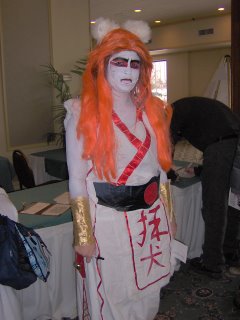
Figure 3: An example of “crossplay”.
Works Cited
Clark, Katerina and Holquist, Michael. Mikhail Bakhtin. Cambridge, MA: Harvard University Press, 1984.
Bakhtin, Mikhail Mikhailovich. Rabelais and His World. Bloomington, IN: Indiana University Press, 1984.
Hirschkop, Ken, and Shepherd, David, eds. Bakhtin and Cultural Theory. New York: Manchester University Press, 1989.
Jenkins, Henry. Textual Poachers: Television Fans and Participatory Culture. New York: Routledge, 1992.
Japanese animation, known colloquially as anime, and its related counterpart manga, or Japanese comic books, have recently gained widespread popularity in Canada and around the world. Anime and manga in first appeared in North America in the late 1980s. Facilitated by globalization and the growth of the internet, a steadily increasing amount of such material from Japan has made its way to Canada and the United States. Anime has become a visible presence on Western television (including the Fox Network’s regular Saturday morning rotation) and manga is now readily available in large chain bookstores across Canada. Many of the more dedicated fans of these Japanese products regularly attend anime conventions. Toronto is hosts two major conventions, which can draw crowds of nearly 10,000 people, primarily high school and college students.
On the weekend of November 25 – 27, 2005, a new convention was held at the Doubletree International Plaza Hotel in Toronto called “Con no Baka”, literally translated as “Convention of Fools”. The carnivalesque elements inherent in conventions become immediately apparent not only from this title, but from the mascot of the event: a girl drawn in the anime style wearing the outfit of a medieval court jester, a figure common in Carnival (Fig. 1). Upon entering the hotel, a noticeable change was apparent in the body language and speech of the attendees, compared to those on the street outside. The majority of the participants in the event spoke extremely animatedly with grandiose gestures and in unusually loud voices, and also employed a normally unacceptable level of profanity, yelling, and screaming. A much higher level of physical contact was evident as the fans interacted in a seemingly violent but friendly way. For example, a common sight during the opening hours of the convention was the “glomp”, a powerful and crushing embrace delivered from a running start designed to knock the recipient over, but also to show extreme affection. This excessive action could be enacted on both strangers and acquaintances alike without repercussion. Upon inquiry, several fans recognized that such behaviour was acceptable only within the convention, and that they would never act in such a way anywhere else: “At con[vention]s you can do things that are far outside of general social restrictions, and regular people don’t have the same kind of outlet”, one attendee stated. Such free intermingling of bodies is indicative of the Bakhtinian Carnival, as is the obviously extreme body language and interaction (Clark and Holquist, 1984).
One of the most common features of the anime convention is known as “costume play”, usually abbreviated to “cosplay”, where fans spend a great deal of effort and expense to create and wear elaborate costumes of characters from their favourite anime or manga. Cosplays can consist of brightly coloured wigs, detailed props, and can be quite revealing, as well as drastically different from anything one might seen the average person. The fans wearing the most outrageous and daring outfits are the stars of the convention, and receive much attention from admirers throughout the course of the weekend (Fig. 2). Such costumes are an excellent illustration of the celebration of the body and of the fluid concept of identity found in the carnivalesque (Wills in Hirschkop and Shepherd, 1989). A woman visiting the hotel for an unrelated event compared the scene before her to Halloween, another recognizably carnivalesque event. The transgression of social norms and reversal of status so fundamental to Carnival may be seen in “crossplay” (cross-dress cosplay), another type of costuming common at conventions in which men and women adopt the costumes and mannerisms of a character from the opposite sex (Fig. 3). Prizes were awarded to those with the strangest apparel as well as the best “crossplayer”, and several panel discussions were held on the methods and execution of cosplay, enculturating newer fans into the practice.
As described by Clair Wills, carnivalesque events are renowned for their openness and for publicizing what would normally be considered private and not acceptable for conversation, depiction, or enactment (Wills in Hirschkop and Shepherd). At Con no Baka, young females could be found in hallways and panel rooms openly discussing and sharing yaoi, or graphic male-male homosexual pornography, without any care for who might happen to overhear or disapprove. Other examples of tabooed or delicate issues of sexuality were proudly displayed throughout the hotel, including gay and lesbian interaction and bondage. The staff at both the booths representing Gaylaxicon (the international science fiction/fantasy convention for gay, lesbian, bisexual, and transgendered fans) and Toronto Trek (the oldest and most established convention in Ontario) agreed that the community found at conventions is a great deal more accepting of all forms of sexual orientation. The mere existence of an event like Gaylaxicon speaks of the high ratio of fans in the community who ascribe to what would traditionally be considered an “unconventional” lifestyle.
Outside of the convention, the majority of fans at Con no Baka attend middle or high school or a post-secondary institution and work unrewarding part-time jobs, thus occupying positions with very low social, economic, or political status or influence. Due to this fact, the carnivalesque dissolution of distinctions of class and displacement of social force would indeed be very appealing to such a disenfranchised group. One teenage fan proudly declared, “Here, we have the power”. In the carnivalesque convention space, standard economic or political status has absolutely no meaning, and those formerly marginalized groups move to the forefront and control the events that occur (Bakhtin, 1984). As argued by communication theorist Henry Jenkins (1992), a new hierarchy appears in the fan world, and finds the most creative fan producers as the highest in status. The most admired members of the fan community at Con no Baka were the authors of successful “fanfiction” (fan published stories based on the characters or plot of an anime or manga), the highly skilled cosplayers, and the creators of the most technically challenging and aesthetically pleasing anime music videos (or AMVs). Jenkins recognized this role of fanfiction in his studies on science fiction fan culture: “…fan publishing constitutes an alternate source of status, unacknowledged by the dominant social and economic systems but personally rewarding nevertheless” (Jenkins, p. 159). Individuality and inventiveness were the main factors in gaining power in the fan hierarchy, as one cosplayer pointed out: “It doesn’t matter how much money you have, only how creative your costume is.”
Cultural capital in the fan world could also be achieved through knowledge, as fans that are able to speak Japanese or were familiar with the most intimate details of a particular show, author, or actor are deferred to as authorities on issues of debate. The only openly derided members visible at the convention were the newest fans, as they are assumed to have the least knowledge and held the lowest position in the fan hierarchy. Many fans mentioned a group they called the “elitists”, who openly scorn those who mispronounce Japanese words or err in their knowledge of the media, the only open discrimination that was observed to occur during the course of the event.
It must be noted, however, that while knowledge and creative production do grant some fans slightly more status than others, the hierarchy is very vague and there is apparent social mobility. Carnival is utopian and egalitarian in the extreme, and focuses on brotherhood and universalism (Bakhtin). Even if one fan were to gain status based on their creativity, they are not granted any special privileges and have no power over others. Equality and fairness appeared to be of special concern to the fans at the convention, as at panel discussion the moderator would make a special effort to allow younger fans or the soft-spoken to include their thoughts, even if they had not put up their hand. A vendor at the booth for a popular Toronto comic store affirmed that simply being a fan was all that was of importance at a convention, because all fans are “looked down upon equally by others”. Another fan said, “Everyone is united by their shared geekiness… You may have no idea what their name is or where they come from, but … we’re all geeks together”, emphasizing the egalitarianism and communal atmosphere of the convention.
While the freedom of the convention space was esteemed by all that attended Con no Baka, such parity and openness is only temporary. Bakhtin explained Carnival’s reversal and transgression as a provisional release, where the inferior are momentarily elevated to allow the traditional hierarchy to remain intact and continue to prevail over the potentially anarchistic lower orders (Bakhtin in Clark and Holquist, 1984). Although fans from across southern Ontario gather together in a utopian community, conventions only occur for at most three days, and Con no Baka was cancelled after only two due to a dispute with the hotel. Once a fan steps outside the convention space, they re-adopt all the traditional norms they had previously left behind. The dramatic gesticulations and speech are abandoned, costumes are exchanged for street clothes, and each attendee returns to their separate home.
In addition, the communal environment of the convention also masks its fundamentally capitalistic roots. The primary action to take place at Con no Baka was shopping, with the Dealer’s Room as the largest and busiest area of the entire event; it was the first place to visit upon arrival, and the last place to explore before departure. Although many fans pointed to participating in the community or meeting new friends as the most important factor in attending a convention, the overwhelming majority answered that they attended the convention for the shopping. Members of an anime club from New York State underwent a seven-hour bus trip simply to shop at Con no Baka.
For those involved in the anime subculture, the convention is the place in which they are able to freely embrace an alternate society; one in which age, gender, sexual orientation, and other traditional status indicators have no bearing on one’s position. Individuality and creativity were honoured, but fans were also able to enjoy an unprecedented level of equality amongst their peers that they are not able to experience outside of the event. The convention also displayed all the visible markers of a Bakhtinian Carnival, through the spectacle of the body language and speech of the attendees, their costumes, and their interactions with one another. However much the fans valued their openness and equality in direct opposition to the outside world, the events at Con no Baka remained grounded in capitalism and are only temporary, with no power whatsoever to affect any real change on society.
Appendix:
Illustrations
Figure 1: The Con no Baka mascot dressed as a court jester.

Figure 2: One of the award-winning costumes at the convention.

Figure 3: An example of “crossplay”.
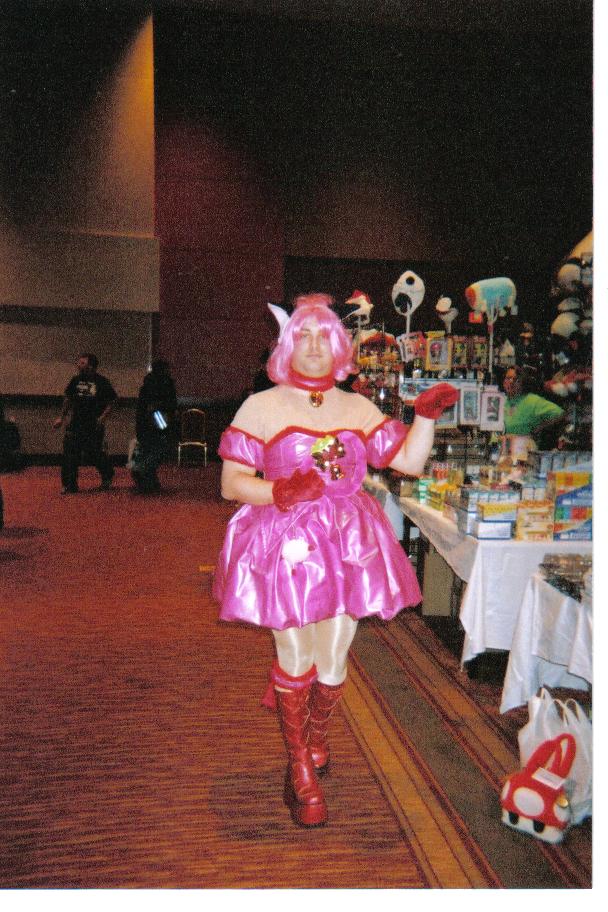
Works Cited
Clark, Katerina and Holquist, Michael. Mikhail Bakhtin. Cambridge, MA: Harvard University Press, 1984.
Bakhtin, Mikhail Mikhailovich. Rabelais and His World. Bloomington, IN: Indiana University Press, 1984.
Hirschkop, Ken, and Shepherd, David, eds. Bakhtin and Cultural Theory. New York: Manchester University Press, 1989.
Jenkins, Henry. Textual Poachers: Television Fans and Participatory Culture. New York: Routledge, 1992.
Thursday, March 16, 2006
Not dead!
In a perhaps futile attempt to revive this dead blog, I shall post a quote regarding sexual orientation that I found to be quite intriguing:
"Insistence on having a sexual orientation in sex is about defending the status quo, maintaining sexual differences and the sexual hierarchy; whereas resistance to sexual orientation regimentation is more about where we need to be going."
- John Stoltenberg, 1989.
Thoughts, anyone? Agree or disagree? Find this man to be an idiot, or enlightened?
"Insistence on having a sexual orientation in sex is about defending the status quo, maintaining sexual differences and the sexual hierarchy; whereas resistance to sexual orientation regimentation is more about where we need to be going."
- John Stoltenberg, 1989.
Thoughts, anyone? Agree or disagree? Find this man to be an idiot, or enlightened?
Subscribe to:
Posts (Atom)